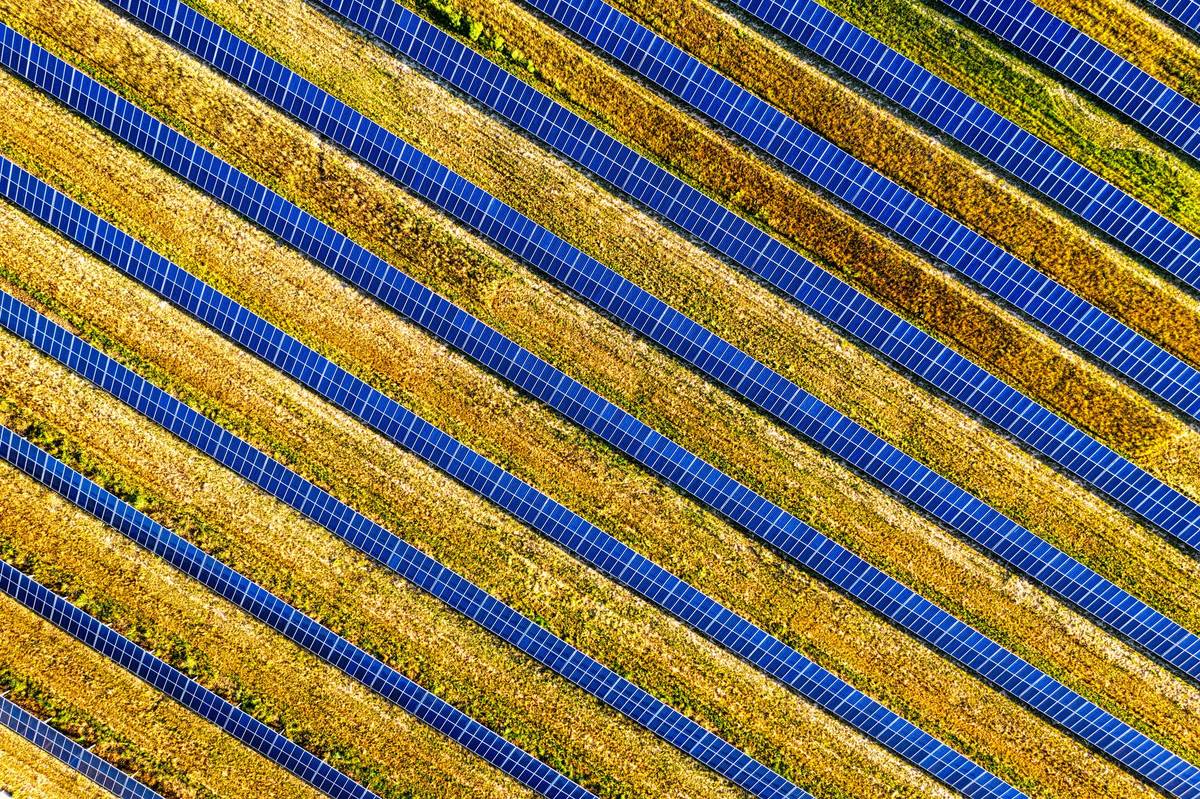
The world's installed solar capacity has passed three terawatts. The third of those terawatts took less than three years to build. The first took nearly seven decades after the silicon solar cell was invented in 1954.
The speed is the real news. Yale Environment 360, citing Bloomberg, dates the crossing to March 2026. A single terawatt is conceivably enough to power the entire United States, the magazine notes. The world passed one terawatt in 2022 and two in 2024.
The counts differ a little by source. The trade body SolarPower Europe put the global fleet above three terawatts on the strength of 2025 alone, when a record 664 gigawatts went up. The IEA's Photovoltaic Power Systems Programme counted 2,974 gigawatts at the end of 2025 and put annual additions at an estimated 698 gigawatts. Either way, the fleet has roughly tripled in four years.
The buildout has moved south
The first terawatt went up mostly in wealthy countries, underwritten by subsidies. That is no longer where the growth sits. BloombergNEF expects nine terawatts by 2036 and projects that poorer countries will by then have installed more solar than rich ones, China aside.
Energy shocks are doing much of the persuading. In Pakistan, Nigeria and Cuba, households have bought imported panels as fossil fuel prices climbed. Pakistan has also seen a surge in battery sales. China accounts for more than half of all installations worldwide and doubled its battery storage capacity last year, according to the energy think tank Ember. Its latest Five-Year Plan sets out to add more storage still.
Solar led primary energy growth in 2025 and overtook gas for the first time, meeting 27 percent of the additional demand, SolarPower Europe reports. "The solar age is firmly established," said the group's chief executive, Walburga Hemetsberger.
Growth is nonetheless slowing. Annual additions rose 16 percent in 2025, against 28 percent in 2024 and 93 percent in 2023, the IEA programme found. Chinese module prices have fallen more than 60 percent since early 2023, which is why panels are affordable in Lagos and Karachi. The same collapse has pushed Chinese manufacturers' cumulative losses towards five billion dollars since early 2024. A 25-year warranty is worth only as much as the company behind it.
The bottleneck has also shifted. In a growing number of markets it is no longer the price of the panel but the permit, the grid connection and the risk that the power will be curtailed or sold at a negative price. Global solar penetration now stands at roughly 10.5 percent of electricity demand, and 35 countries theoretically exceed 10 percent. Above that level, transmission lines and storage decide how much of the generated power is actually used.