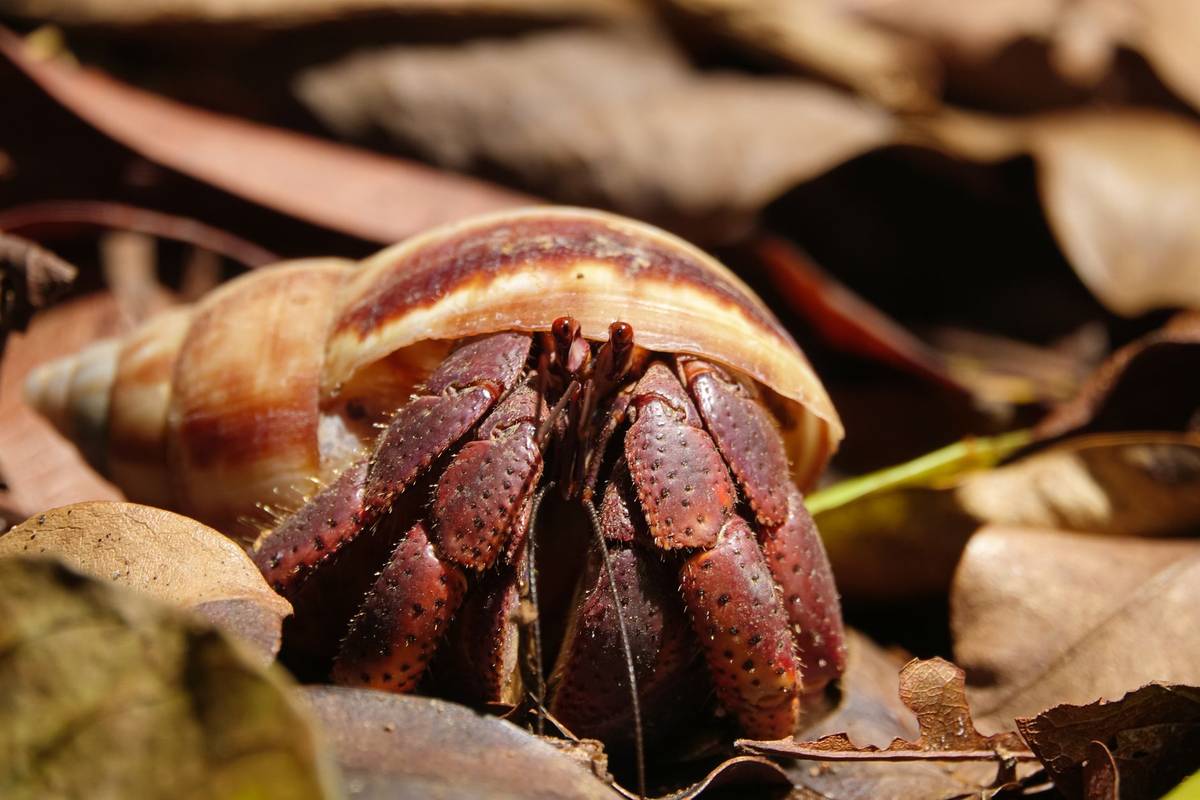
A camera trap on the Japanese island of Ishigaki has settled a long-standing puzzle in plant ecology. Land hermit crabs, not ants, carry off the seeds of the parasitic plant Balanophora fungosa. The botanist Suetsugu Kenji of Kobe University describes the finding in the journal Ecology.
The plant looks like a small mushroom on the forest floor. It has no chlorophyll and feeds on the roots of nearby trees, Mongabay reports. Each specimen produces up to a million tiny seeds, every one wrapped in a dry fruit. How those seeds travelled was unknown. "Many people assumed that they simply fall by gravity and are carried away by the wind, but the humid and windless forest floor makes this seem rather implausible," Suetsugu said in a statement from Kobe University.
He first suspected ants. The fruits are dull in colour, easy to detach and smell of yeast. So he covered some plants with mesh nets that let ants through but kept larger animals out. The fruits went untouched.
Suetsugu then set a waterproof camera about 20 centimetres from the plants. It fired every 50 seconds and gathered 6,427 images across nearly 89 hours, Mongabay writes. The pictures showed land hermit crabs of the species Coenobita brevimanus and Australian cockroaches gathering at the fruits after dark.
Seeds that survive the gut
The crabs move seeds in two ways. On average 86 fruits clung to the outside of their claws. They also ate fruits and passed intact seeds that stayed viable. The animals can range about 100 metres, Popular Science reports, which takes the seeds well clear of the parent plant. The cockroaches excreted far fewer intact seeds.
"This study provides the first empirical evidence that hermit crabs can function as both external and internal seed dispersers," Suetsugu writes in the paper.
The crabs turned up only around mature plants. The fermented smell of ripe fruit is the likely lure. Seed-dispersal research has concentrated on birds and mammals, Suetsugu told Mongabay, and that focus can leave interactions on shaded forest floors unnoticed.
Whether the pattern holds elsewhere is untested. Suetsugu points out that land hermit crabs are common in coastal forests and eat almost anything they can reach. On that basis he expects a more general role for them, though a single island study cannot show it. The work was funded by the Japan Science and Technology Agency.