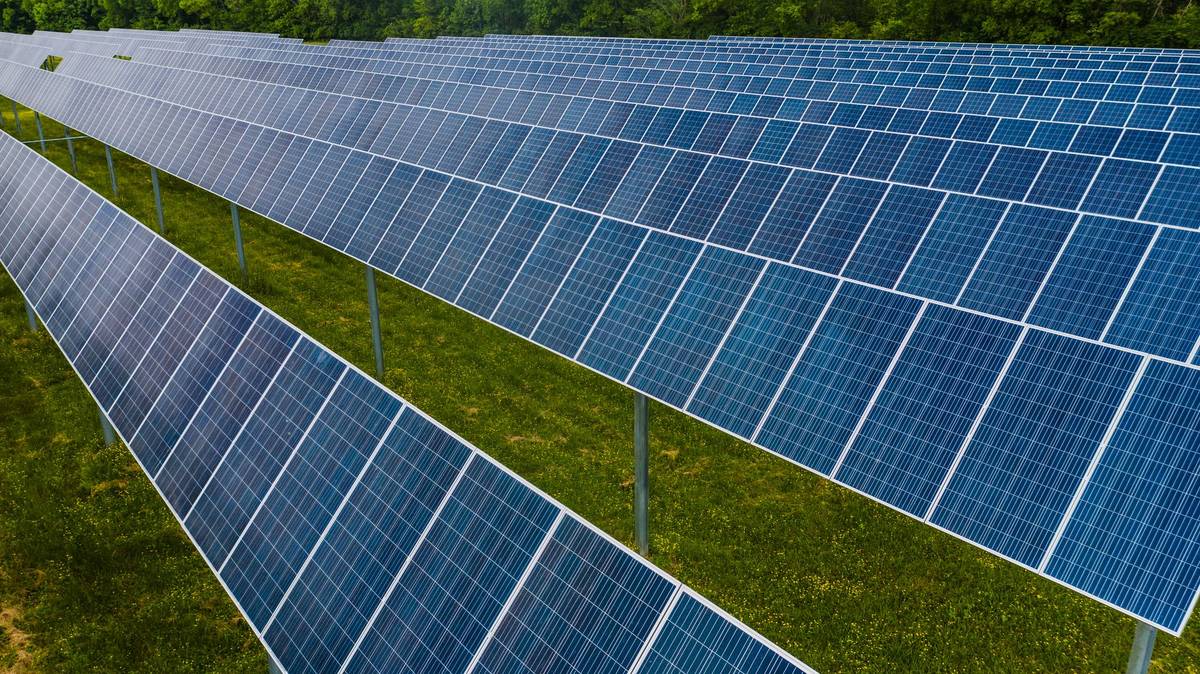
Putting solar panels over a tomato field lowers the temperature the pickers feel by an average of 4.46 degrees Celsius. That is the result of a new simulation from Princeton University.
The study by Erfan Hosseini and Elie Bou-Zeid appears in the Journal of Advances in Modeling Earth Systems. It deals with agrivoltaics, the practice of growing crops beneath or between rows of solar panels. Most work on the idea has measured one field site at a time. This model instead builds the microclimate under the panels from physical principles.
It follows how energy, momentum and mass move through the whole system. Panels, soil, plants, air, water and the uptake of carbon dioxide are all included. The authors tested it against real measurements, using leaf temperatures recorded in Davis, California, and soil temperatures from Chicago City, Minnesota, the journal Eos reports.
They then ran a hypothetical tomato farm through a hot, humid summer day in New Jersey.
What the shade changes
Under the panels, tomato leaves ran 1.84 degrees cooler on average than in the open, and as much as 7.56 degrees cooler at the worst of the afternoon. Water loss from the leaves fell by 22.4 percent a day. Counting the soil as well, Anthropocene Magazine reports a daily drop of 42.6 percent.
The crop paid for that with light. The shaded plants received 47 percent less direct sunlight, yet their photosynthesis fell by only 31 percent. The cooler air appears to offset much of the loss.
The panels benefited too. Moisture evaporating from crop and soil cooled the hardware by 5.6 degrees, recovering about 15 percent of the efficiency that heat normally costs a solar cell.
For the people in the rows, the model turned a perceived 39 degrees into roughly 35. "Outdoor workers bear the brunt of this heat, and their drop in productivity has wider socio-economic repercussions," the two authors told Anthropocene Magazine.
None of this has been measured on a working farm. The point of the model, the authors say, is to test designs "before spending money on hardware". They caution that agrivoltaics "is not one-size-fits-all", and that results will shift with the crop and the climate.