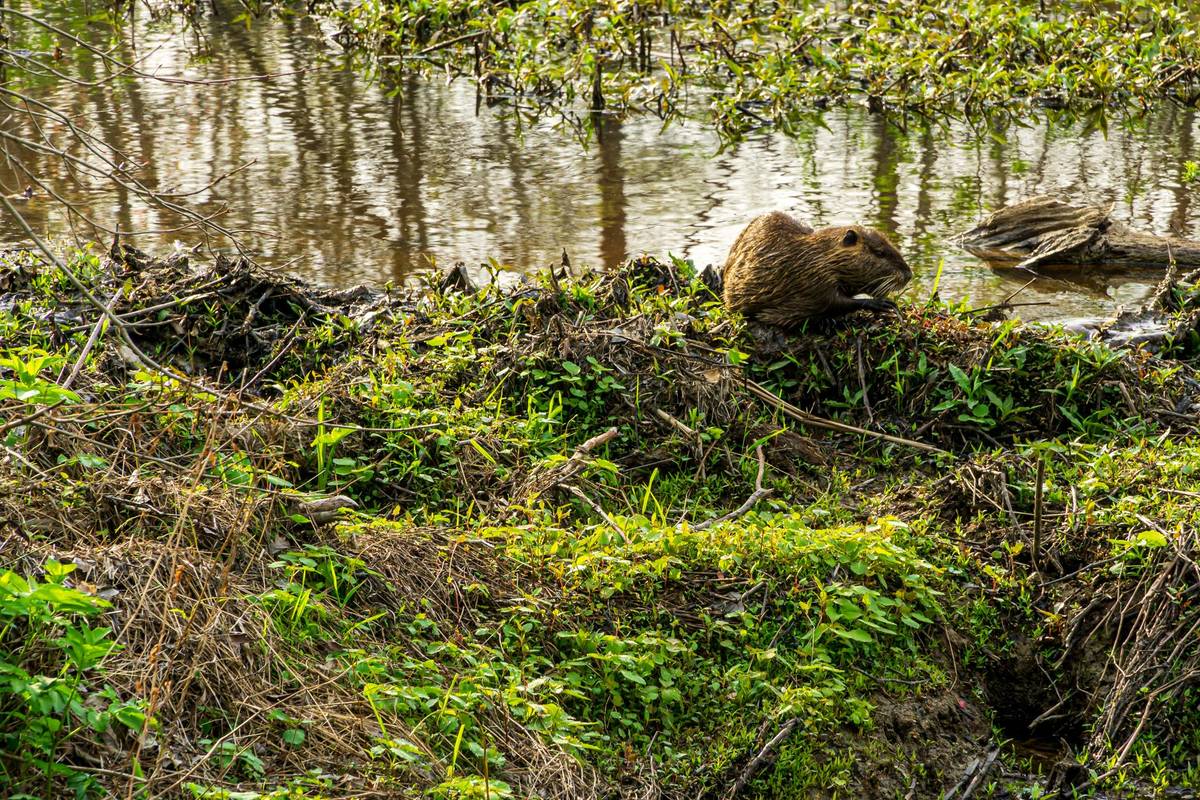
Beaver dams are keeping parts of the English landscape wet while more than half the country sits in drought. Dr Alan Puttock of the University of Exeter says the ponds and dams the animals build hold water back and slow its flow. That gives wildlife a refuge in an otherwise parched countryside.
The scale is measurable. Researchers at Exeter and Devon Wildlife Trust combined drone imagery with water-depth monitoring across four beaver family territories. Together those wetlands were storing more than 24 million litres of water, an average of six million litres per site. That is roughly ten Olympic swimming pools held behind the dams.
The same structures work in the opposite weather. Using Environment Agency river gauging data, the researchers found that beaver dams and their wetlands cut storm flows by an average of 30 percent during heavy rainfall. Each wetland pond holds about 1,000 cubic metres of water and releases it slowly through leaky dams.
Why a drained landscape dries out faster
Modern landscapes tend to be extensively drained, Puttock says. Water runs off quickly when it rains, which raises the flood risk and leaves little in the ground for dry spells. Beaver wetlands reverse that pattern. They hold water in place and let it seep back into rivers over weeks rather than hours.
The side effects are practical. According to the Press Association, the wetlands bring several practical benefits. They supply grazing and drinking water for livestock and maintain river flows so water can still be abstracted. They also buffer flash floods when rain hits baked ground, and can even act as a firebreak. Aerial images of the River Otter catchment in Devon show green wetland while the surrounding land has turned brown. Drought has been declared in Devon, as in many parts of England, and some areas of the county have gone 50 days without rain.
Beavers were hunted to extinction in Britain around 400 years ago. A wild population was discovered on the River Otter in 2014, and in 2020 the animals were granted the legal right to stay. Devon Wildlife Trust now counts about 20 family territories along the river and its tributaries. In February 2026, four pairs were released into the Par and Fowey rivers in Cornwall.
Puttock is careful about the claim. "One beaver wetland won't solve all of our drought problems," he said. "But overall, as beavers expand in our landscapes, and also as we do other nature-based solutions or wetland creation schemes, it does mean that we are less prone to droughts."