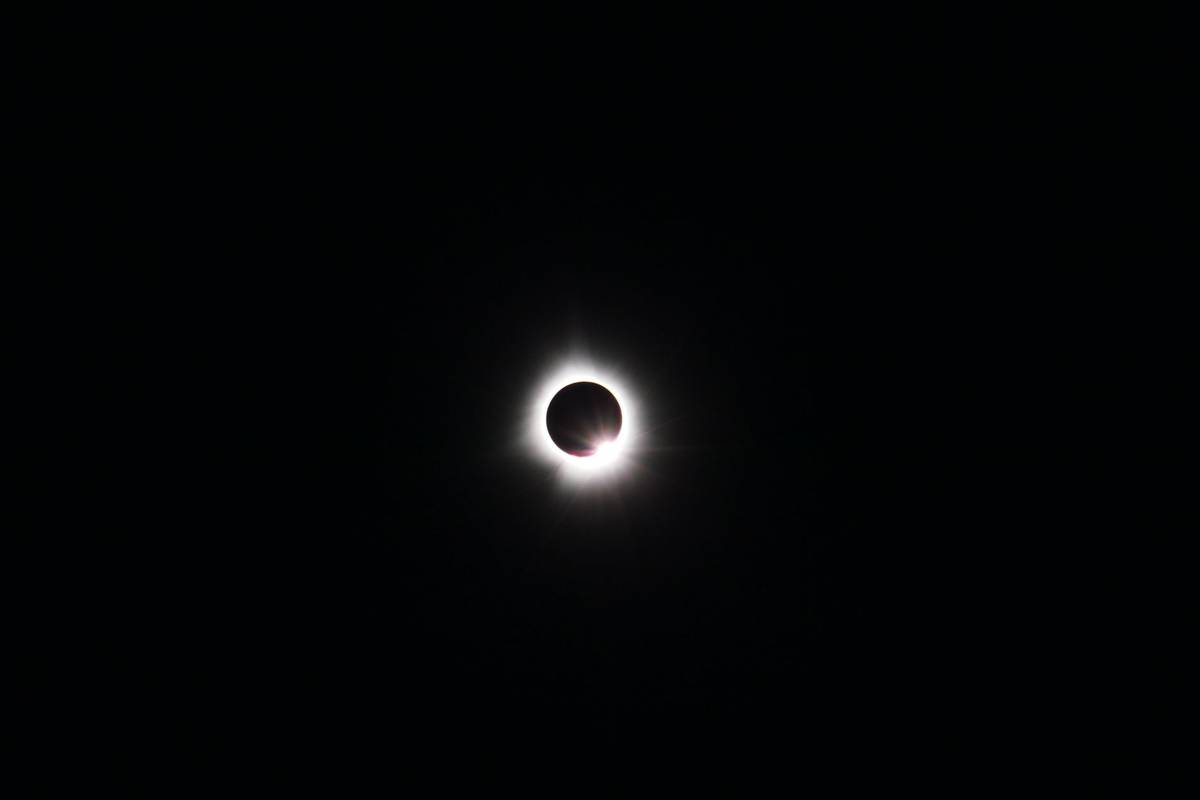
The moon slid squarely in front of the sun over Iceland and northern Spain on 12 August 2026. It was mainland Europe's first total solar eclipse since 1999.
More than 15 million people live inside the narrow band of total darkness, according to Smithsonian magazine. Just under a billion live in the far wider zone that could catch at least a partial eclipse. The shadow also crossed northern Russia, eastern Greenland and a small corner of Portugal.
For Spain the moment was rarer still. Not since 1905 had the moon blotted out the sun entirely over the Spanish mainland, CNN reported. On Mallorca, watchers broke into applause while boats sounded their horns offshore. In the fjords of Greenland the crowd fell silent instead. Birds in Iceland began calling as they do at dusk, an observation the New York Times reporter Amelia Nierenberg made and Smithsonian relayed.
Outside the path of totality the effect was still marked. Berlin saw 85 percent of the sun covered and Paris 92 percent, CNN reported. New York City reached 9 percent and Philadelphia 7 percent. In the United Kingdom more than 90 percent disappeared, and the partial eclipse peaked shortly after 19:00 BST. BBC science correspondent Pallab Ghosh watched totality from Burgos in northern Spain and said the spectacle gave him goosebumps.
Why researchers wait years for these minutes
Totality is more than a show. It uncovers the corona, the sun's wispy outer atmosphere, which the star's own glare normally hides. In the seconds before and after, sunlight streams through valleys on the lunar surface and produces the bright points known as Baily's beads.
The alignment rests on what NASA calls a cosmic coincidence. The sun sits roughly 400 times farther from Earth than the moon does, and it is roughly 400 times larger. Both therefore look almost the same size from the ground, so the moon can cover the sun exactly.
The next chance comes soon. A total eclipse will cross southern Spain, North Africa, Saudi Arabia and Yemen on 2 August 2027, CNN reported, with totality lasting more than six minutes. Ryan French, a solar astrophysicist at the Laboratory for Atmospheric and Space Physics in Boulder, Colorado, called it "the one to be at because it will actually be the longest eclipse in the remainder of our lifetimes". Viewers in the contiguous United States face a far longer wait. Their next totality falls on 22 August 2044, over North Dakota and Montana.