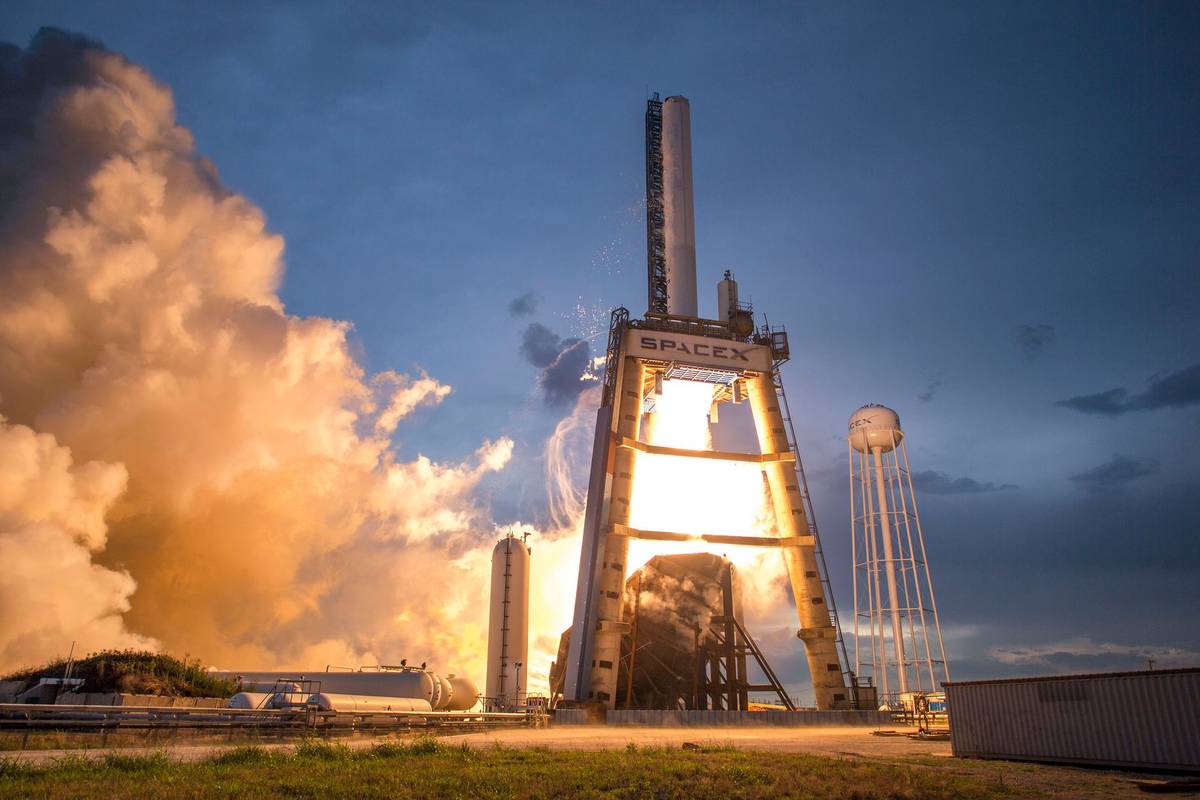
A SpaceX Falcon Heavy carried NASA's Nancy Grace Roman Space Telescope off the ground in Florida on 30 August 2026, opening a five-year survey of the universe.
Liftoff came at 7:26 a.m. EDT from Launch Complex 39A at the Kennedy Space Center, NASA reported. Roman is the agency's next flagship observatory. It joins Hubble and the James Webb Space Telescope, but it is built for breadth rather than for single deep stares. The telescope is named after NASA's first chief astronomer.
The rocket's 27 Merlin engines produced more than 5 million pounds of thrust, according to NASA. The first stage consisted of a centre core and two side boosters. The upper stage carried the observatory.
Roman is now travelling to Lagrange point 2. That position lies nearly 1 million miles from Earth, on the side facing away from the Sun. It keeps the telescope's view clear of the planet.
What the telescope will do
"That means that we have a wide open view of the sky that really exceeds anything in low Earth orbit like Hubble could achieve," project manager Jackie Townsend said at a prelaunch briefing on 29 August, quoted by Space.com.
Once working, Roman will take thousands of images a day. It is meant to map billions of galaxies, measure the effects of dark matter and dark energy, image planets around other stars directly, and study black holes. NASA expects the sheer volume of data to support far more research than the mission's own five-year programme.
Nicky Fox, associate administrator for NASA's Science Mission Directorate, put the scale in plainer terms at the same briefing. The telescope, she said, "is the size of a tour bus, and it weighs the same as a T-Rex". She added that Hubble and Webb "kind of peer through a keyhole at the universe, while Nancy Grace Roman will kick the door down".
Getting off the pad was not certain. Forecasters had given the Sunday window only a 50 percent chance of acceptable weather, Space.com reported, with offshore cumulus clouds the main worry.
Science does not begin at once. Roman needs roughly three months of instrument deployments, calibration and checkout while it travels out to its operating orbit. NASA expects the first science images in early 2027.