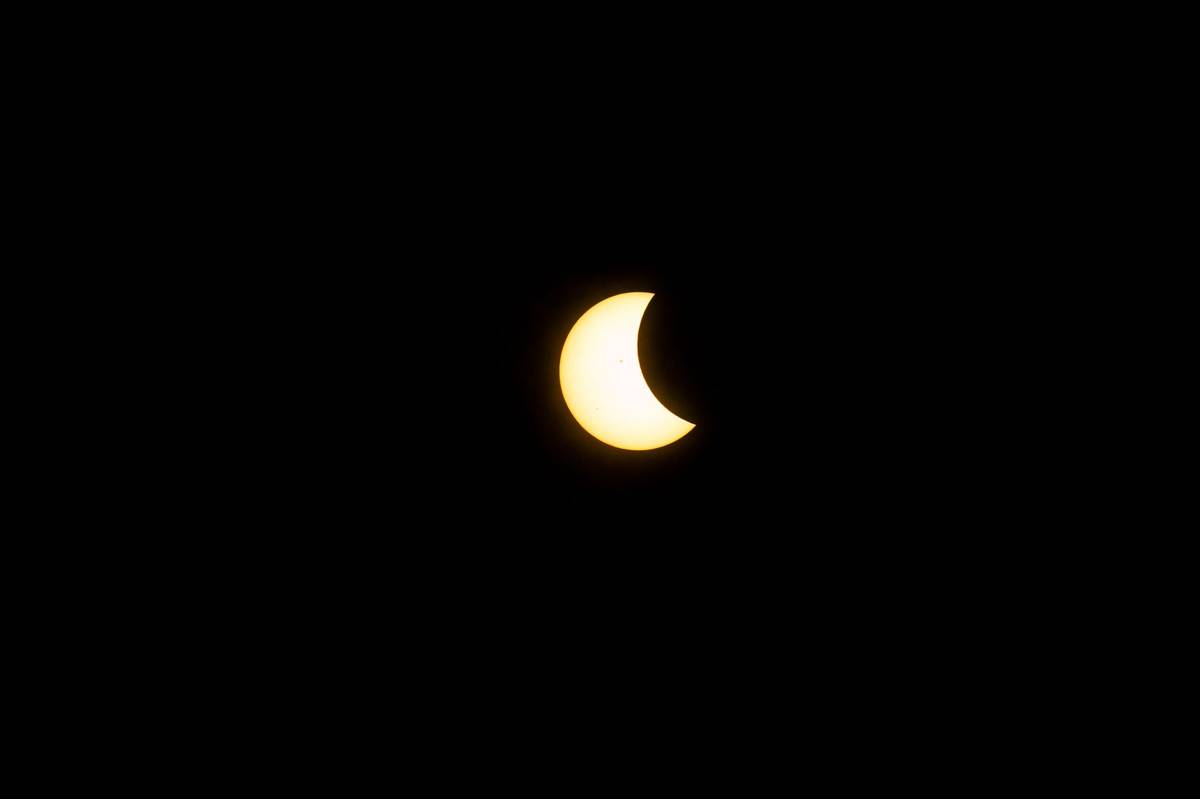
On 12 August the Moon will pass in front of the Sun. Europe gets its first total solar eclipse in two decades, though only along a narrow strip. The Moon's umbra first touches the Earth in the Arctic and then crosses Greenland, Iceland, Spain and a small part of north-eastern Portugal. Anyone hoping to see the Sun fully covered, and its corona, has to travel there.
Germany gets a partial eclipse. Depending on location, the Moon will obscure up to roughly 90 percent of the Sun's visible disc, according to the European Space Agency. The same applies to Austria and Switzerland. The sky will not go dark but stay bright. There is a further complication. In this part of Europe the eclipse only begins shortly before sunset, so what is on offer is a setting crescent Sun, which requires a clear view of the horizon.
The spectacle is possible thanks to a coincidence of scale. The Sun is about 400 times larger than the Moon and also roughly 400 times further away. From Earth both therefore appear as discs of about half a degree across. The Moon's umbra is narrow. The zone of totality is usually only around 200 kilometres wide, while the penumbra extends some 3,500 kilometres to either side.
An event with a history
For Spain the date is historic. It will be the first total solar eclipse visible from the Spanish mainland since 1905. The last one visible from mainland Europe was in 2006. Spain will host Europe's largest area of totality this time. The eclipse crosses the country from west to east and continues over the Balearic Islands. It is also the first of three eclipses visible from Spain between 2026 and 2028.
ESA is marking the event with its own programme of observation, science communication and educational activities. It points to its solar missions Solar Orbiter, Smile and Proba-3.
One warning belongs with every eclipse. Looking at the Sun is dangerous without certified eye protection, even when it is partly covered. Sunglasses, exposed film or smoked glass are not sufficient. What is needed is certified eclipse glasses or proper filters fitted in front of a camera lens or telescope.