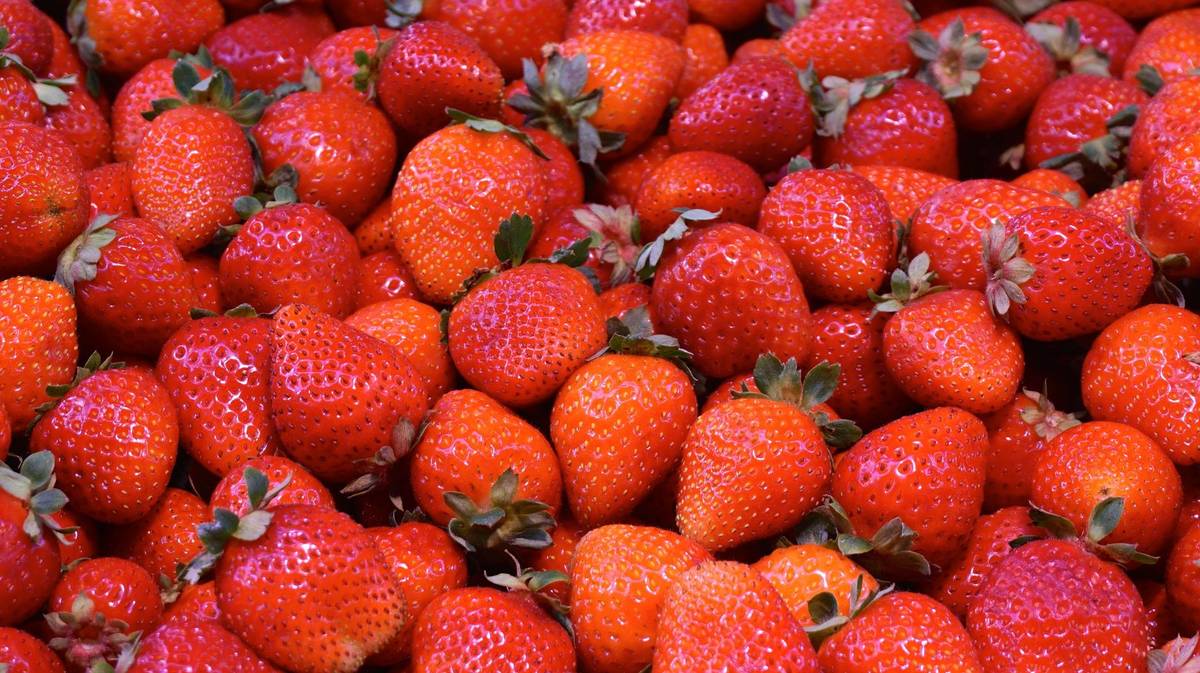
A coating made from red seaweed kept strawberries free of mould for four days at room temperature. Untreated berries sitting in a refrigerator began to spoil on the fourth day.
The result comes from a team at the University of British Columbia in Vancouver and appeared in the Journal of Agricultural and Food Chemistry. UBC announced it on 4 August 2026. It suggests a way to slow spoilage without the energy cost of keeping produce cold from farm to shelf.
The main ingredient is agar, a gelling agent from red algae already common in food as a vegan substitute for gelatine. On its own, agar sets into a thick gel. Mixed with zinc and with tannic acid, a plant compound found in tea and grapes, it behaves differently. The three components organise themselves into microscopic particles that spread as a thin, clear film over anything dipped in the liquid.
"It was exciting to watch the particles self-assemble in real time, from a cloudy, milky liquid into this incredibly uniform, protective layer," said Ivy Chiu, a doctoral student and the study's lead author. To the team's knowledge, no agar-based microparticle coating of this kind existed before.
Grapes gained a week
The researchers tested strawberries, grapes and apple slices, both inside and outside a fridge. Untreated strawberries at room temperature developed mould within two days, while coated ones lasted at least four. Coated berries kept cold stayed sound for six days. Treated grapes went almost 14 days before wrinkling, a full week longer than untreated fruit. Coated apple slices held for roughly 24 hours against about 12.
Water loss after four days fell from 30 percent to 13 percent, Anthropocene Magazine reports. The coated fruit stayed noticeably firmer and retained more vitamin C and antioxidants. The researchers describe the layer as antibacterial, safe to eat and easy to wash off.
"We wanted to find a simple alternative to cold storage," said Tianxi Yang, an assistant professor in UBC's faculty of land and food systems and the study's senior author. "Once we added the coating, the fruit became far less sensitive to changes in temperature and moisture and stayed fresh longer."
The stakes are large. Nearly half of all food produced in Canada is lost or wasted, at an estimated cost of 58 billion dollars a year, according to UBC. A life-cycle analysis found the coating's emissions were equal to or lower than refrigeration, though the gain per piece of fruit was modest. Whether it adds up depends on scaling the method to commercially available agar and to a wider range of produce, which the team has not yet done.