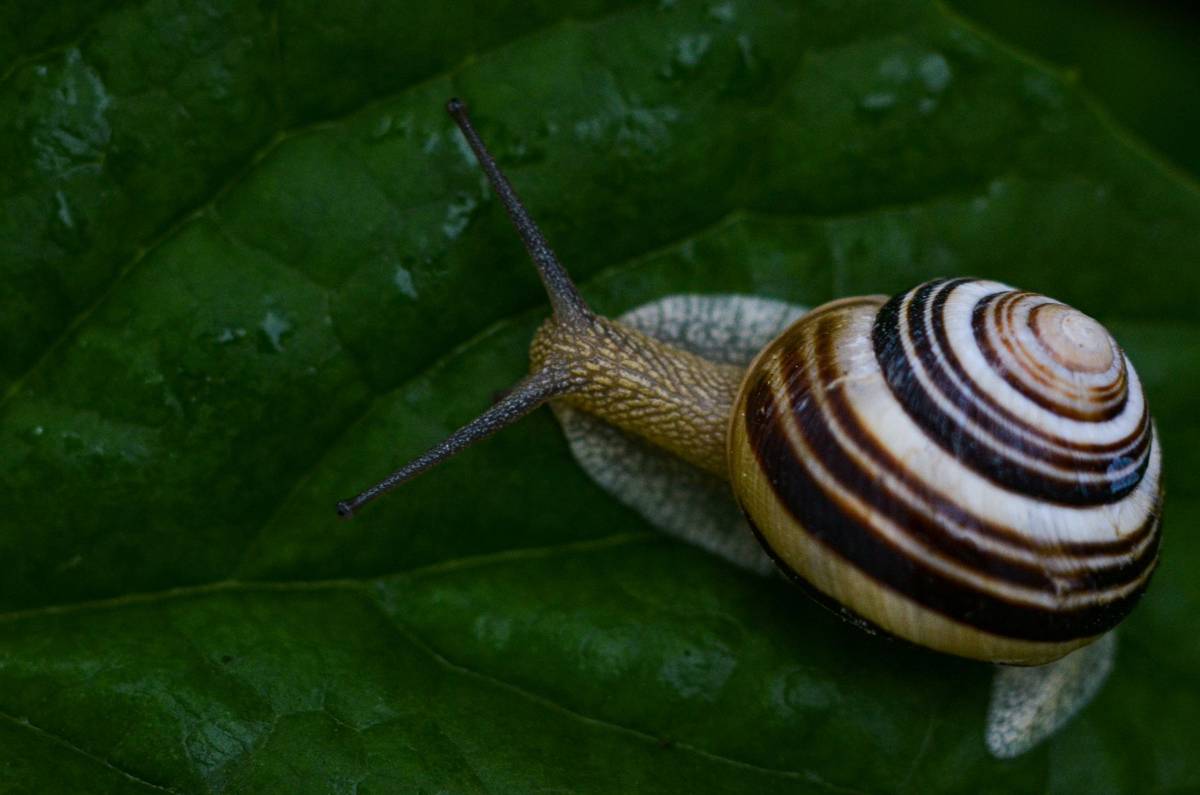
The brown-lipped snail does not produce one slime. It produces five, and each has a different job. A team at the Max Planck Institute of Colloids and Interfaces in Potsdam collected the secretions separately and analysed them. The results appear in the journal Science.
In the garden it is mainly the trail that catches the eye. The snail glides on a lubricant mucus. With an adhesive mucus it anchors the rim of its shell to a surface. Disturbed, it releases either a sticky yellow slime or a mass of fine bubbles. For dormancy it seals the shell with the epiphragm, a mineralised layer.
The composition surprised the researchers. "We were very surprised by the proteomics results because of how similar the composition was throughout, although they look and behave completely different," Franziska Jehle told the trade magazine Chemical & Engineering News. The biomaterials researcher led the study.
All five types consist mainly of water, glycoproteins and complex carbohydrates. The team identified collagen VI as the main structural component. The difference lies in quantity. The yellow defensive slime is about four per cent protein and the foamy one only 0.6 per cent, wissenschaft.de reports. For the lubricant, Chemical & Engineering News gives roughly 0.3 per cent. Protein content governs how each material responds to shear.
Calcium is the second control. The snail stores it as amorphous calcium carbonate in its glands and secretes it together with the mucus. In wet slime it supplies ions that cross-link the protein network. In the epiphragm it serves as a precursor to calcite. The team confirmed that crystalline form by X-ray diffraction. The protective slime carries the highest calcium content.
Processing shapes the material too. The yellow and the foamy defensive slimes are chemically similar but structurally different. The yellow one is fibrous, while in the foam the collagen gathers around the bubbles. The snail creates that foam by pushing air through its breathing hole.
Aravind Madhyastha of the Ashoka Trust for Research in Ecology and the Environment was not involved in the study. He considers the epiphragm the most remarkable part. Something soft and slimy becomes a mineralised barrier that carries the animal through drought or cold.
Whether any of this ever becomes material for people is open. The researchers point to adhesives, wound dressings and carriers for drugs. So far nobody has shown that the fine interplay of calcium and protein can be rebuilt outside a snail.