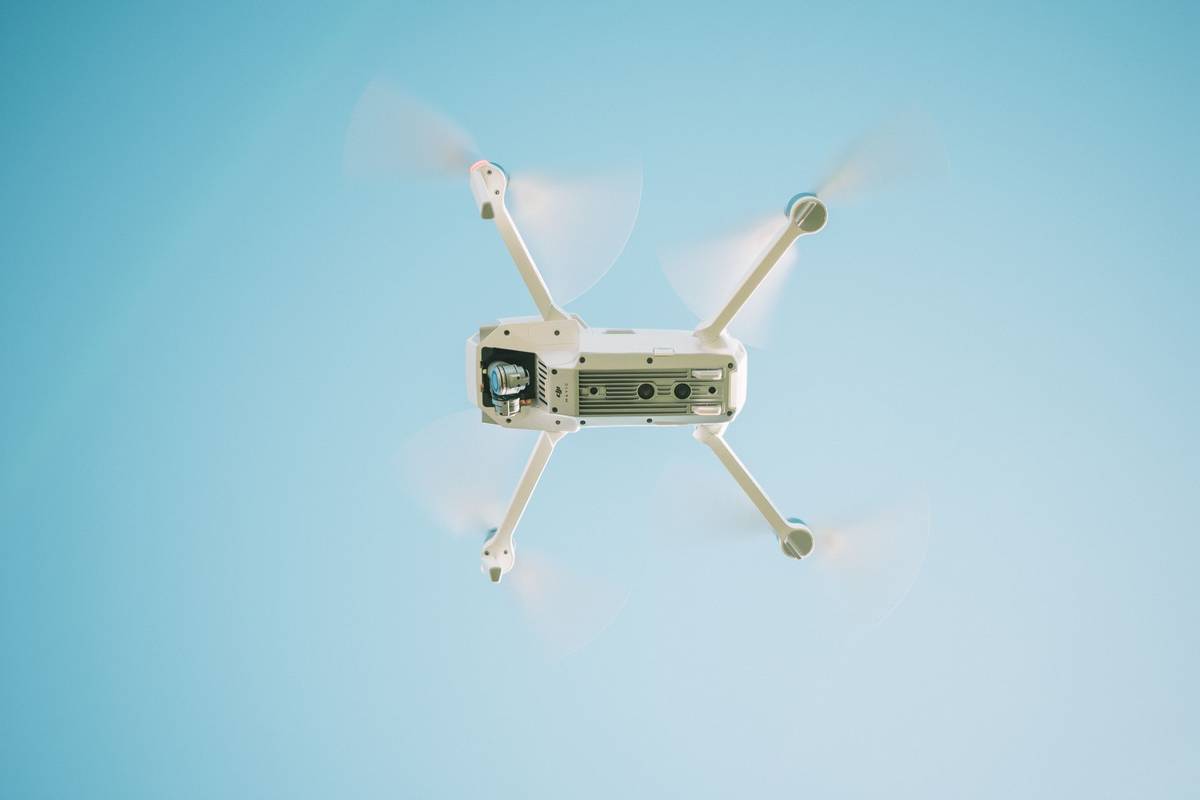
Anyone deploying a drone today counts in three-quarter hours. Most craft stay airborne no longer than about 45 minutes before the battery has to be swapped or recharged — a rhythm that chops up inspection flights over railway lines, wind turbines or forests. A team led by Jianhua Han at the Civil Aviation University of China has now built a receiver that could break that rhythm: it charges the drone remotely by laser beam while it flies.
The trick lies in a two-layer component mounted under the wing. The upper layer is made of perovskite, a semiconductor material tuned here not to sunlight but to the narrow colour spectrum of a laser, from which it generates electricity directly. Beneath it sits a thermoelectric layer that draws additional energy from the temperature difference between the irradiated side and the side facing away — putting to use precisely the heat that an ordinary solar cell would lose.
That heat was the main problem at first. Under intense irradiation the component warmed to between 80 and 90 degrees Celsius, considerably more than expected, and risked being damaged. The researchers therefore embedded special nanocrystals in the cell that conduct heat poorly and slow the heat flow. The receiver now withstands longer exposure — and keeps its efficiency.
That efficiency is remarkable: in testing, the device converted 38.49 percent of the incoming laser energy into electricity. The measurements were made on a square cell 1.2 centimetres on a side, illuminated with green laser light at a wavelength of 530 nanometres and a power density of 1.2 watts per square centimetre; in a wind tunnel the harvested energy was enough to drive a propeller. The team presented its results in the Cell Press journal Matter & Light.
Another practical feature is that the drone solves its own cooling problem: in flight, the airflow from the propellers cools the far side of the thermoelectric layer and thereby sustains the temperature difference from which it generates power.
Even so, application remains distant. So far the team has measured only in the laboratory on a stationary model; the next step is to test the technology on a drone flying outdoors, and the researchers themselves point to numerous unsolved engineering questions. If that step succeeds, it changes the shape of many civilian missions: drones that survey forests, monitor disaster zones or deliver parcels would no longer need to touch down for energy. "As drones take on longer missions, battery life has become one of the biggest barriers," Han says.