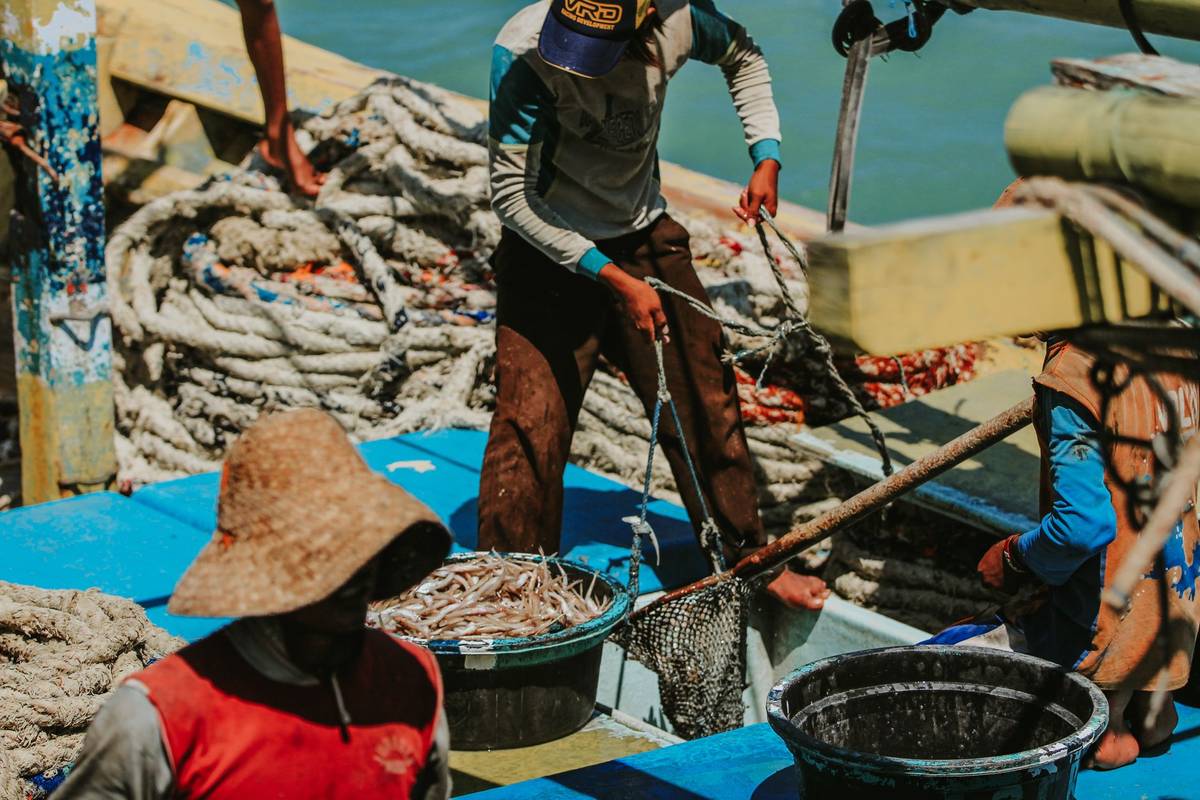
An ordinary deckhand on an Indonesian fishing vessel earns around 25,000 rupiah a day, roughly $1.40. Endi, 42, who moved to the boats after construction work left him worn out and underpaid, told Mongabay that a two-month voyage yields between 1.5 and 6 million rupiah ($84-$334) depending on rank – not enough, he said, to keep a family. Work like his is now covered, for the first time, by an international rulebook.
This spring the government ratified the International Labour Organization's Work in Fishing Convention, known as ILO 188, in Presidential Regulation No. 25 of 2026. The treaty sets floors that Indonesian law has never applied to fishing crews as a group: minimum age, written contracts, limits on working and rest hours, decent accommodation and food on board, occupational safety, medical care at sea, social security and legal protection. Jakarta has a year to rewrite the rules governing recruitment, training, certification and crew management before those standards take effect.
What makes the step more than symbolic is the gap it addresses. Nabiyla Risfa Izzati, who teaches labour law at Universitas Gadjah Mada, points out that seagoing crews sign maritime employment agreements governed largely by the Commercial Code rather than the Labour Law – a regulatory dualism that leaves the Ministry of Manpower unable to intervene fully when rights are violated. Syofyan Razali of Team 9, a coalition of unions and civil society groups, describes the same terrain from the other side: fragmented regulation, unclear authority over labour inspections, and no clear legal definition of a fishing crew member at all.
Effects that reach past the deck
Better labour standards are also expected to help at sea. Analysts quoted by Mongabay argue that reducing incentives for exploitation weakens illegal, unreported and unregulated fishing, which tends to travel with abusive labour in seafood supply chains, and that documented crews make Indonesian exports easier to trace and easier to sell into markets with strict sustainability rules. Brant Connors of the International Maritime Health Association notes the scale involved: fishing employs more than 15 times as many people as merchant shipping, in one of the world's most hazardous industries.
The hard part is enforcement. Fis Purwangka, who researches occupational safety at the Bogor Institute of Agriculture, wants binding provisions for vessels above 30 gross tonnage, certified emergency medical personnel, mandatory health insurance and better onshore medical facilities – while warning that some operators may reflag abroad to avoid compliance. Inspecting a workplace that sits far offshore remains difficult, and crews who fear for their jobs rarely file complaints. Arnon Hiborang, who heads the North Sulawesi branch of the fishing crew union SAKTI, puts the expectation plainly: "There should be no gray areas anymore."