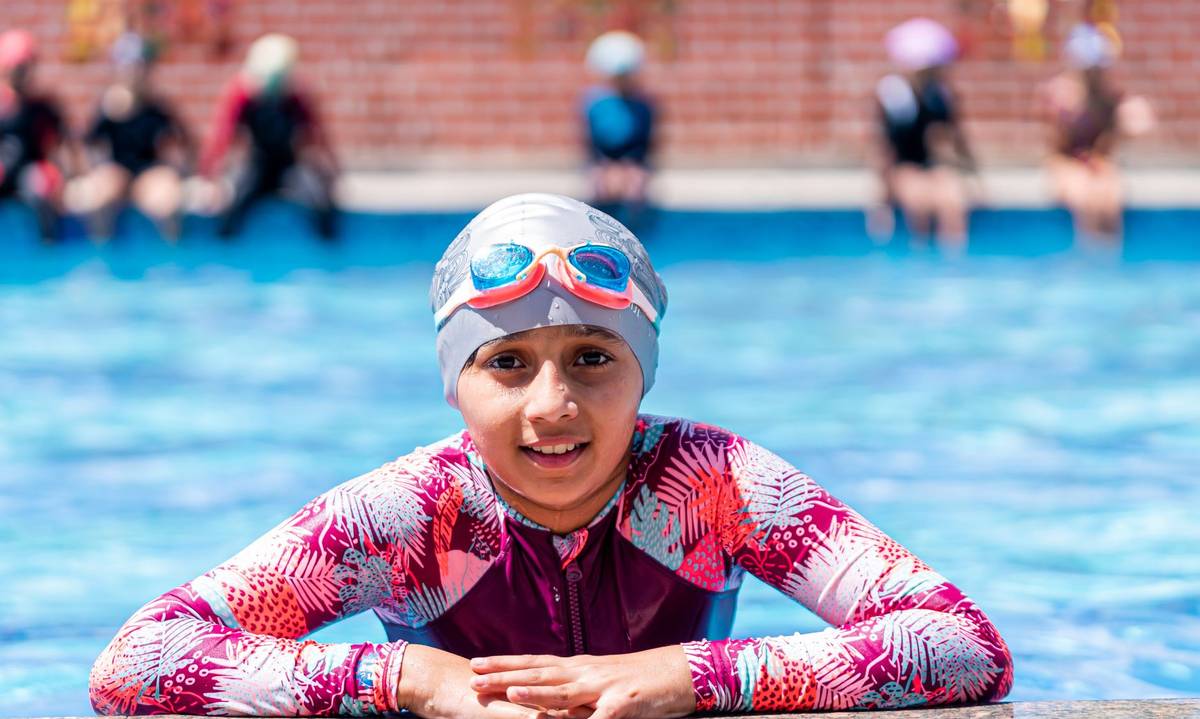
From this school year, every child in Kassel's second-year primary classes spends a full school week at the swimming pool. Around 1,400 pupils are taking part in the first round.
The project is called "Kasseler Welle" and is run jointly by the city and the University of Kassel. The letters stand for the German words for experiencing water, learning and saving lives. According to the university, no comparable programme exists elsewhere in the German-speaking world. The aim is not a swimming badge but safety in the water.
The routine is the same for every class. Over five consecutive days the children spend 90 minutes a day in the water, the University of Kassel says. They practise gliding, floating, breathing, surfacing and jumping. Short theory sessions cover pool rules, how dangerous situations arise and simple measures for rescuing themselves and others.
Two lanes at the Auebad are reserved for them each day. Height-adjustable underwater platforms sit in the two-metre-deep swimmers' pool, hessenschau reports. Instructors use them to match the water depth to each child's level. Coloured wristbands show that level. Red marks children who are still fearful, blue those who are confident.
Students run the sessions
The groups are led by more than 50 sports students from the University of Kassel. They take a new course on teaching and assessing swimming competence. Each child's progress is recorded digitally.
"This is not about getting a swimming badge as quickly as possible," said Nicole Maisch, the city councillor for education, in the university's statement. Children should gain confidence in the water and learn to judge danger. Mayor Sven Schoeller says the goal is that no child leaves primary school unable to swim.
Diving is a particular focus. Sebastian Fischer of the Institute of Sport and Sport Science told hessenschau that diving away horizontally is "one of the most vital strategies in the water". No swimming badge tests it, he said. The situation he has in mind is a capsized stand-up paddleboard floating overhead.
Families pay nothing. School buses run by the Kassel transport company take the classes to the pool. The schools provide teachers, the municipal utility provides the pools, and donations cover the rest.
Nineteen of Kassel's 26 primary schools are taking part in the first year, with the others to follow. By 2030 more than 8,000 children should have gone through the programme, according to the city. Whether it also reduces the number of swimming accidents will take years to show.