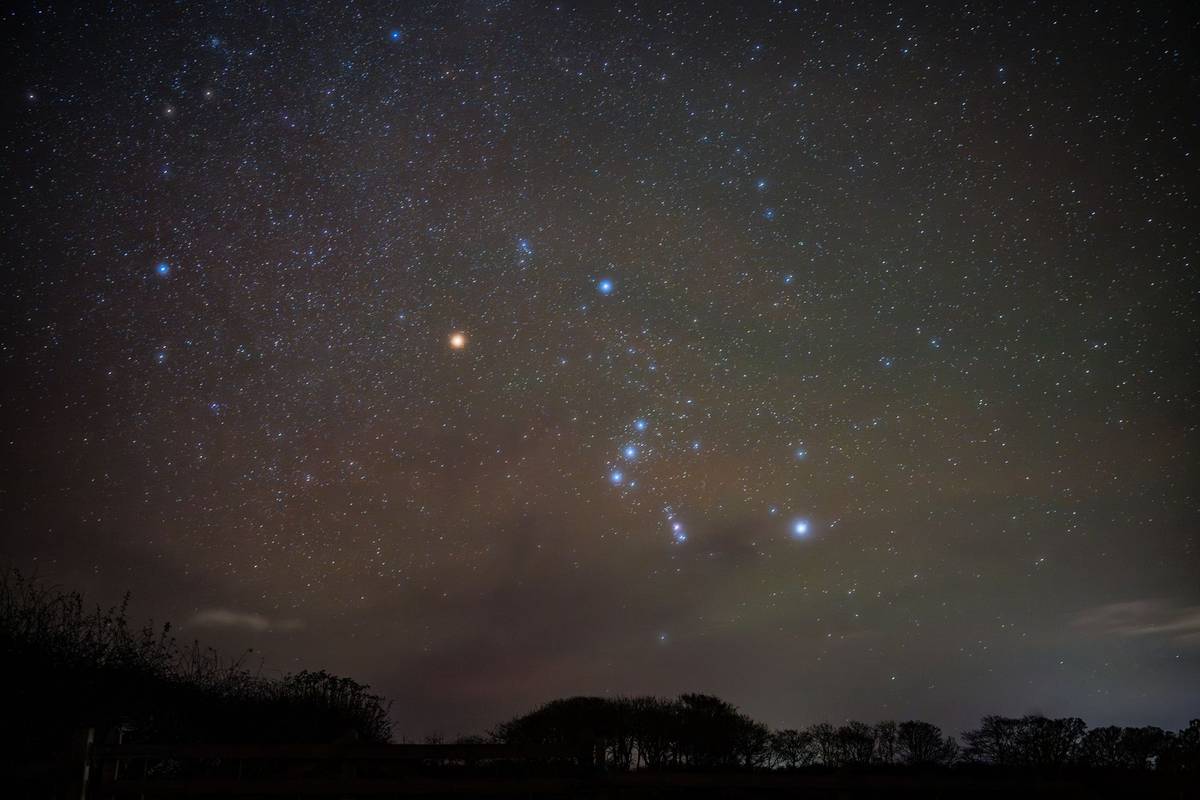
For a century it was an inference drawn from regular fluctuations in brightness: Betelgeuse, the red star marking Orion's shoulder, does not travel through space alone. Now the sharpest image of that partner exists — and with it formal confirmation that one of the best-known stars in the night sky is a binary.
The difficulty was never distance but contrast. Betelgeuse is a red supergiant some 700 light years away, and it outshines everything near it. "Spotting a small companion next to Betelgeuse is a bit like trying to photograph a firefly beside a lighthouse," says Emma Bordier of the University of Cologne, a co-author of the study.
Two papers published in 2024 supplied the decisive clue: the suspected companion should reach its widest apparent separation from the supergiant, as seen from Earth, in December 2024. A team led by Miguel Montargès duly pointed the SPHERE instrument on the European Southern Observatory's Very Large Telescope in Chile at the pair — an instrument built for hunting exoplanets. What mattered next was months of processing, in which the glare of Betelgeuse was computationally stripped out of the images.
Six point one sigma
"I jumped out of my chair when I saw the processed images," Montargès reports; he had not expected the sensitivity to suffice. In the cleaned data, the second point of light sat exactly where the orbital calculations had placed it. The astronomers put the statistical significance at 6.1 sigma — comfortably past the five-sigma threshold at which an observation counts as a confirmed detection in physics. The results appeared in the journal Astronomy & Astrophysics.
That closes a search which began in the 20th century and repeatedly came up empty. A first, blurred direct image was obtained in July 2025, suggesting a bluish star of roughly one solar mass. In January 2026 came evidence of a bow wave the companion carves through the supergiant's extended atmosphere. The new picture is the most detailed view of Betelgeuse B so far.
What makes the find consequential is what lies ahead for Betelgeuse. The star is far along in its evolution and will — soon, in astronomical terms — explode as a supernova. Its conspicuous dimming from 2019 to 2020 briefly fed speculation that the end was imminent, but proved to be the aftermath of an enormous plasma eruption. A different question now stands open: what part does a close companion play in how such a star ends? An object nobody could see for a hundred years becomes a fixed element in the models of one of the most spectacular explosions humans may ever witness.