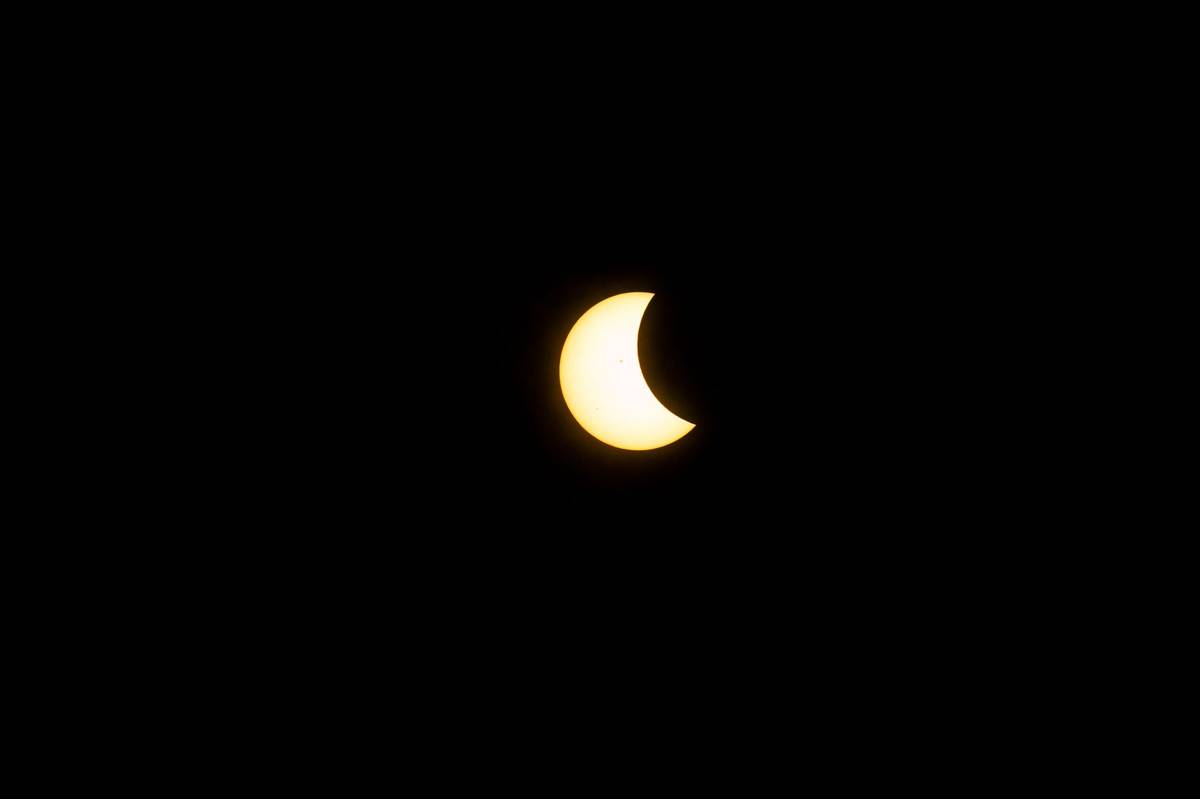
On 12 August the moon's shadow will cross Greenland, Iceland and northern Spain, bringing mainland Europe its first total solar eclipse since 1999. Totality will last at most two minutes and 18 seconds. For Spain it will be the first since more than a century ago.
The shadow starts near the North Pole and tracks south. It needs about an hour and a half to cover its 8,260-kilometre course, most of which runs over open Atlantic, according to NASA. Maximum totality falls off Iceland's west coast. By the time the shadow reaches a small corner of Portugal and then northern Spain, totality is down to roughly a minute, and the sun is close to setting. The path ends over the Mediterranean.
Far more people will see a partial eclipse than a total one. The moon will take a bite out of the sun from Alaska to West Africa, across most of Canada, the northern United States and much of Europe. Coverage reaches 94 percent in Dublin and 83 percent in Oslo, then falls to 18 percent in Montreal, 9 percent in New York and 2 percent in Norfolk, Virginia. In the Channel Islands, the UK and Ireland about 90 percent of the sun will be hidden.
What a 90 percent eclipse feels like
"For many of us who saw the 1999 total eclipse, this is probably the last really big eclipse we'll see," Jean Dean, secretary of the astronomy section of La Société Guernesiaise, told the BBC. Solar eclipses happen somewhere on Earth roughly every 18 months, she said, but from any one place they are a once-or-twice-in-a-lifetime event. Guernsey's next total eclipse is due in 2081.
Cloud would not cancel the experience. It will still go dark and turn slightly cold, Dean said, and the birds will fall silent. She was blunt about safety: eclipse glasses are essential, and sunglasses will not do, even with most of the sun covered.
The day is unusually crowded. Six planets form an arc before dawn, and the Perseid meteor shower peaks after nightfall under a new moon.
Research follows the shadow. The European Space Agency will broadcast from the Javalambre Astrophysical Observatory and hold a public event in León, and two of its space telescopes will observe the sun's corona. NASA will stream its own coverage. More than 60 high-altitude balloons are to be launched from Spain and Iceland by American university teams to study the atmosphere as the shadow passes.
"It's also a very human moment," said Carole Mundell, ESA's director of science. Anyone who misses it has a second chance sooner than usual: a six-and-a-half-minute eclipse crosses Spain, North Africa and the Middle East next summer.