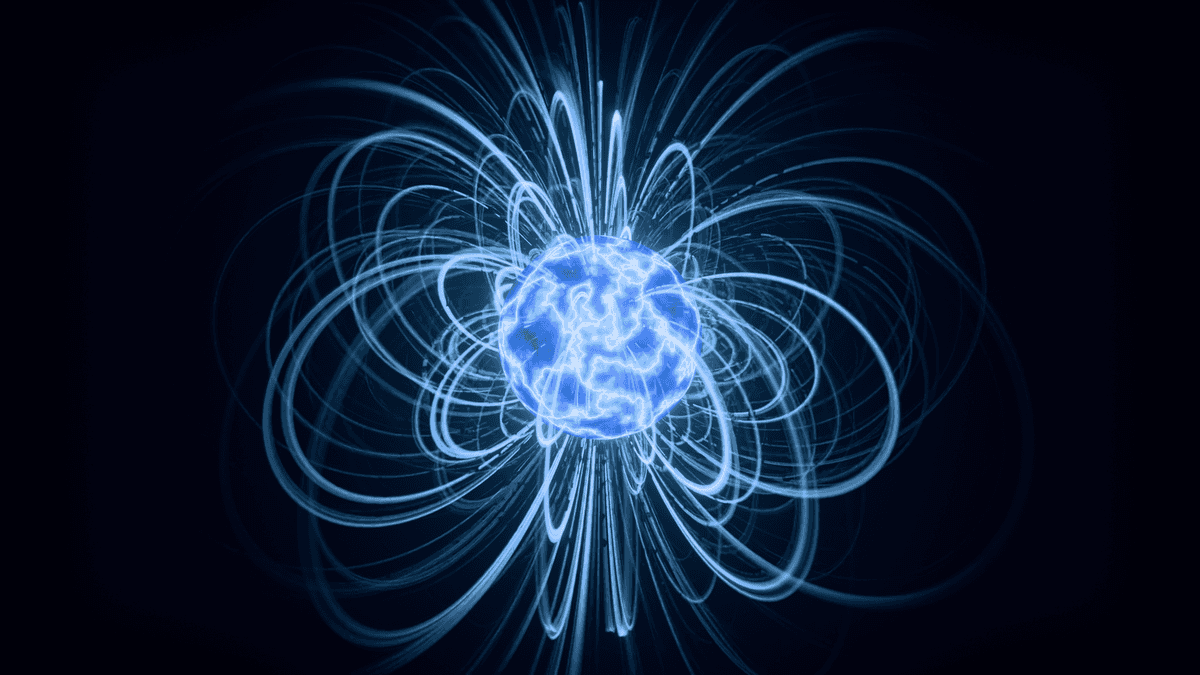
For more than a hundred years, textbooks recognised just two basic families of magnets. Ferromagnets are the everyday kind, the material behind fridge magnets, hard drives and electric motors. Antiferromagnets are subtler: their internal magnetic moments point in opposing directions and cancel out, leaving no external pull. That tidy division has now been broken.
The European Physical Society has awarded its 2026 Europhysics Prize – one of the continent's most prestigious honours in condensed matter physics, handed out since 1975 – to Libor Šmejkal, Jairo Sinova and Tomas Jungwirth for identifying a third elementary class of magnetism, called altermagnetism. Sinova directs the Spin Phenomena Interdisciplinary Center at Johannes Gutenberg University Mainz; Jungwirth is based at the Institute of Physics of the Czech Academy of Sciences in Prague. Much of the decisive theoretical work took shape in Mainz, where Šmejkal was based between 2016 and 2024.
The best of both worlds
What makes altermagnets remarkable is that they combine properties long thought to be mutually exclusive. Like antiferromagnets, they carry no net magnetization, so they produce no stray fields that interfere with neighbouring components. Yet like ferromagnets, they can generate strong spin-polarized electrical currents – and they do so at ultrafast terahertz speeds.
That mix is exactly what the emerging field of spintronics has been missing. By exploiting the spin of electrons rather than just their charge, altermagnets could enable computer memory that is faster and far more energy-efficient, with obvious appeal for high-performance and AI hardware. The discovery has also forced a rewrite of the opening chapters of magnetism textbooks and opened links to superconductivity and topological materials.
"Discovering that an entirely new magnetic phase had remained hidden for more than 100 years demonstrates that even the most mature scientific fields can still hold fundamental surprises," Sinova said. The prize will be presented in September at the society's condensed matter conference in Graz, Austria.