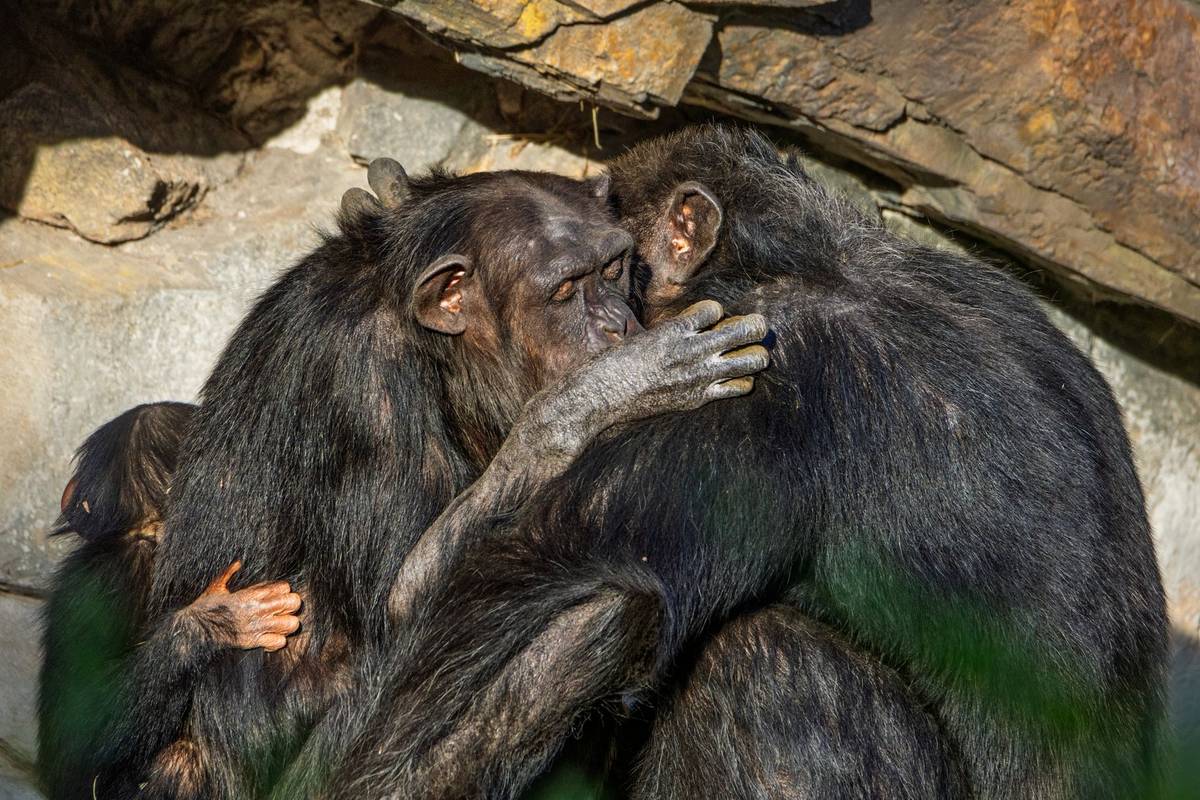
Before a trough of peanuts swings over the fence, the apes already know what is coming. In those tense minutes, bonobos and chimpanzees reach for one another – an embrace, a pat, a kiss. New research suggests the contact is less celebration than insurance: animals that reassure each other beforehand go on to eat side by side more peacefully once the food lands.
The study, led by Durham University's psychology department and published in Proceedings of the Royal Society B, filmed 116 individuals from five semi-wild groups across 60 sessions at two African sanctuaries – Lola ya Bonobo in the Democratic Republic of Congo and Chimfunshi in Zambia. Researchers Zanna Clay and Jake Brooker had gone there on an eight-month trip to study consolation, the way apes comfort one another after a fight, and kept noticing friendly touch happening before any conflict had broken out at all.
To test what that touching was for, the team used a task devised by the Dutch biologist Edwin van Leeuwen. Peanuts are tipped from a bamboo trough into a small shared area, concentrating a valuable resource in one spot much as a fruiting tree does in the wild. Because the apes can watch the trough being filled, the five minutes of anticipation before release can be scored on their own: every embrace, every threat, every act of aggression.
Who reaches out to whom
In both species the pattern held. Individuals who exchanged more reassuring contact beforehand subsequently spent more time feeding alongside others. The effect tracked each species' social architecture: among bonobos it was strongest between females, whose alliances counterbalance male aggression, while among chimpanzees male pairs led, reflecting the coalitions that underpin chimpanzee politics. It also showed up most clearly in the more tolerant groups; where leadership was more authoritarian, the link disappeared.
Some of the contact was startlingly risky. Chimpanzees, particularly males, placed fingers and hands inside one another's mouths and held each other's genitals. In a species capable of lethal violence, the researchers argue, the vulnerability is precisely the message: you put a hand in a mouth only if you are confident it will not close. Such gestures were considerably more common in the more tolerant group, which fits their reading as signals of trust.
Because bonobos and chimpanzees use such similar gestures, the behaviour most likely traces back to the ancestor humans share with both, at least six million years ago. Tolerance – the willingness to share space without aggression – underpins cooperation and social learning across the animal kingdom, and the findings suggest pre-emptive touch is part of how it is maintained. Human parallels are easy to find in work the authors cite: negotiators who shake hands before bargaining lie less and reach better joint outcomes, and NBA teams that touched more early in the 2008-09 season played more cooperatively later. Reaching out before the tension starts turns out to be a very old idea.