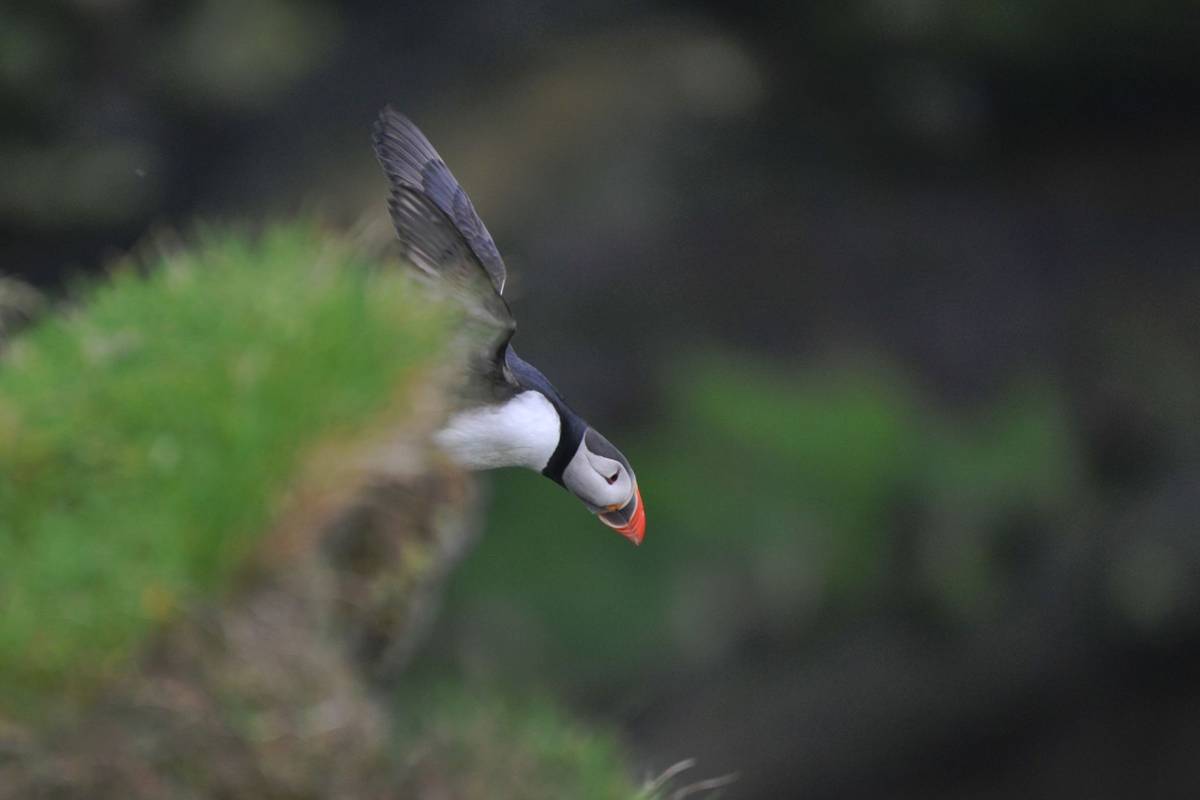
About a hundred bird species earn their living in two fluids at once. Puffins, loons, gulls and petrels chase prey below the surface, then break out and fly away. Copying that trick has defeated engineers for years, and the reason is physical: water is roughly 800 times denser than air, so the wing that carries you through one medium ought to be useless in the other. The obvious workaround – a machine that transforms between two modes – costs weight a small flying robot cannot spare.
A team at EPFL in Lausanne and MIT has now skipped the workaround. Their flapping-wing aerial-aquatic vehicle, or FAAV, weighs under 300 grams and uses a single pair of wings for swimming, surfacing and flight. The results appear in the journal Science.
One pair of wings, two worlds
The machine is deliberately plain: a fuselage holding a battery and a waterproof motor, a crankshaft that drives two flexible membrane wings coated with water-repellent nanoparticles, and a motorised tail that sets the angle of attack. Flexibility turned out to be the crucial variable. The wings must give enough to keep their stroke small in dense water, yet stay stiff enough to generate lift in air.
Tuned that way, the robot flaps about five times a second in both media – close to the rhythm of real diving birds, which flap around ten times a second in air and four underwater – and reaches roughly one metre per second while swimming and six in flight. The researchers first flew and dived it in a tank at EPFL, then took it to Lake Geneva.
The hardest moment is the exit. Surface tension grabs at the wingtips, and the team found that only a steep pitch of about 70 degrees clears them; shallower and the robot is held down, steeper and it tips backwards. One finding surprised the group: most diving birds paddle their feet to get airborne, and the robot needs no feet at all. Wing size, flapping rate and tail angle were enough.
Why this matters lies offshore. Ocean measurements today depend largely on research vessels that are expensive and cannot safely approach breaking ice, shallow reefs or wildlife. Lead author Raphael Zufferey, who began the work at EPFL and now leads the AURA Lab at MIT, describes launching such a robot from a boat or a beach to fly out to an iceberg, a port or a pod of whales, dive for a sample and return with the data at a fraction of the cost. The next versions are to get wings that twist as well as flap, so the vehicle can hold its course through gusts and choppy water.