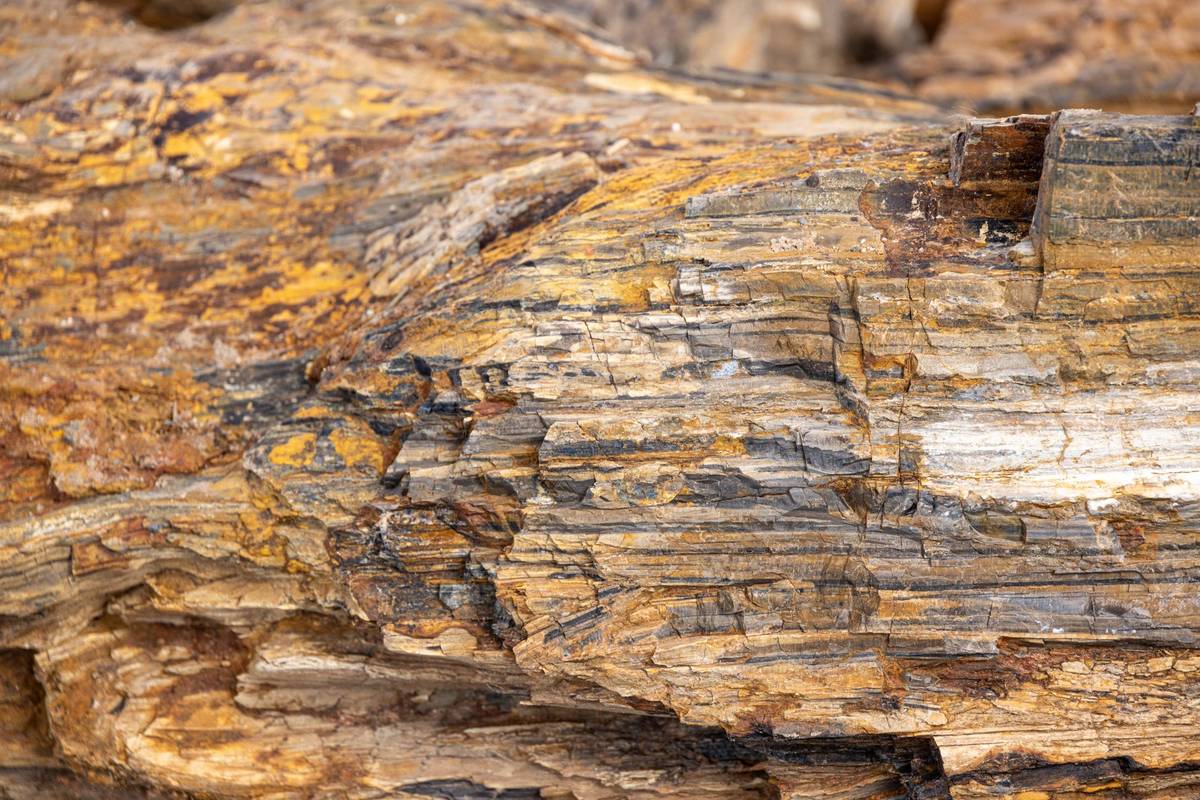
A hand-sized piece of petrified wood from northern Thuringia can tell more than many a drill core: it has recorded the subsidence, heating and uplift of an entire sedimentary basin – across some 300 million years. That is the finding of a team led by the geologist Steffen Trümper of the University of Münster, published in the journal Scientific Reports. Geology thus gains a source of information it had overlooked, because fossilised wood occurs in many rocks worldwide.
The researchers examined the celebrated fossil trunks of the Kyffhäuser Mountains, some up to 20 metres long and known since at least the 18th century. They date from the late Carboniferous, when now-extinct relatives of conifers grew in tropical dry forests near the equator of the supercontinent Pangaea. Floods toppled the trees and buried them in river deposits whose reddish colour comes from iron oxides and points to a warm, seasonally dry climate. Dissolved silicic acid seeped into the dead wood, templated the cell walls and gradually replaced the organic material with minerals.
The key lies in precisely that quartz. Using cathodoluminescence, fluid inclusions, oxygen and silicon isotopes, Raman thermometry, electron-probe microanalysis, scanning electron microscopy and U-Pb dating, the team identified five successive generations of mineral – the longest sequence yet documented in fossil wood. Each generation stores the temperature, pressure and chemistry of the solutions from which it formed.
Down to 5.5 kilometres and back
From that sequence the history of the Saale Basin can be reconstructed, its rocks among the oldest in the Central European Basin System. After the initial silicification the region subsided; particularly revealing were tiny fluid inclusions, which preserve the conditions during crystal growth. They show that parts of the wood lay at depths of three to 5.5 kilometres, at 160 to 240 degrees Celsius. Later the layers rose again, were washed through by hot waters, and finally reached the surface as the Kyffhäuser and the Harz were formed. In total the five stages span roughly 200 million years from the late Carboniferous to the Early Cretaceous; counting the uplift, 300 million years.
The value extends well beyond Thuringia. The Central European Basin System is economically significant – it holds raw materials, groundwater and potential for geothermal energy. Knowing the subsidence and temperature history of such basins more precisely makes them easier to assess. It is astonishing, Trümper says, that a fossil often no bigger than a hand carries within it the development of an entire region across hundreds of millions of years.