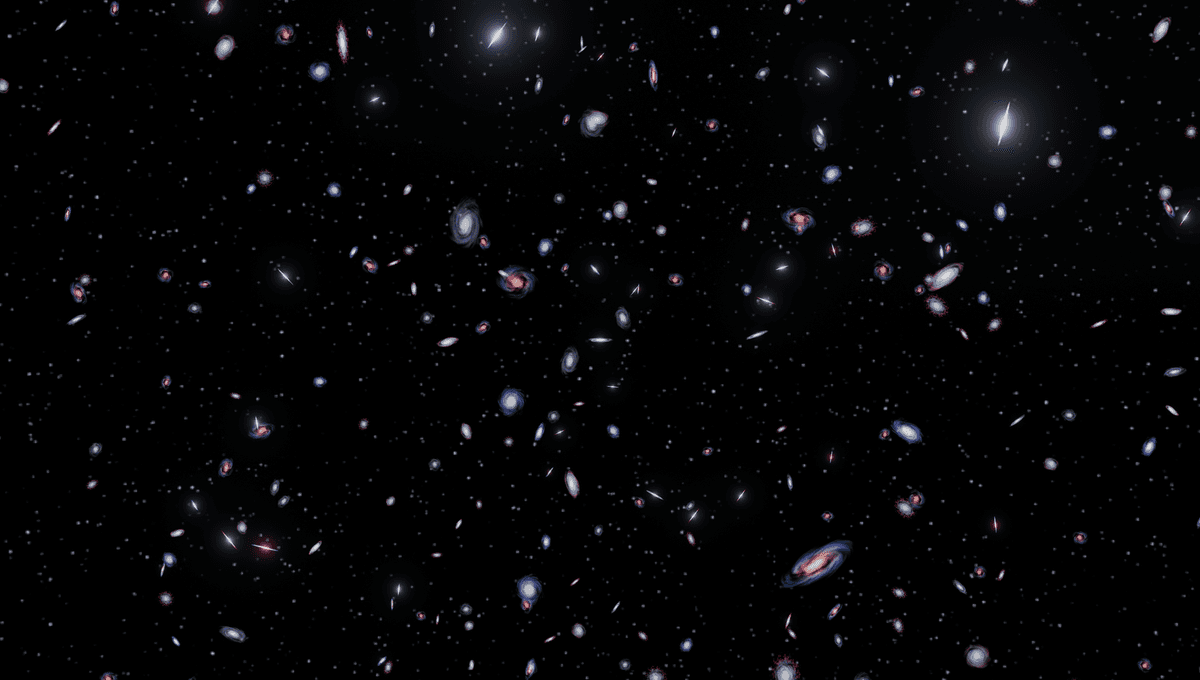
The universe has an accounting problem. Shortly after the Big Bang, roughly a sixth of all matter consisted of ordinary baryons – the protons and neutrons that make up stars, planets and our own bodies. Yet add up everything visible today in stars, galaxies and gas clouds, and you reach only about a tenth of that baryonic matter. The rest was long considered lost.
Now a team at the Massachusetts Institute of Technology, working within the CHIME/FRB Collaboration, has pinned down the missing material – using fast radio bursts (FRBs), millisecond-long, extremely bright flashes of radio waves from distant galaxies.
Smeared signals as a scale
The trick lies in a quirk of these signals: as they pass through matter they are "smeared" out in time, and the more matter lies in their path, the stronger the effect. "We can measure this smearing very precisely," explains lead author Haochen Wang of MIT's Kavli Institute for Astrophysics. The team compared the smearing of thousands of radio bursts with the positions of more than six million galaxies from the DESI survey.
The result: where there are more galaxies, there is more of the previously invisible matter. It sits in extremely thin clouds that envelop groups of galaxies and stretch across roughly four million light-years – far further than models had predicted. The study appears in Physical Review Letters.
The implications go beyond mere bookkeeping. For matter to be flung out that far, processes such as black-hole jets and exploding stars must be more powerful than assumed. "These measurements indicate that star activity, and activity from black holes, is stronger and much more violent than predicted," says co-author Kiyoshi Masui. A decades-old cosmological puzzle has just grown a good deal smaller.