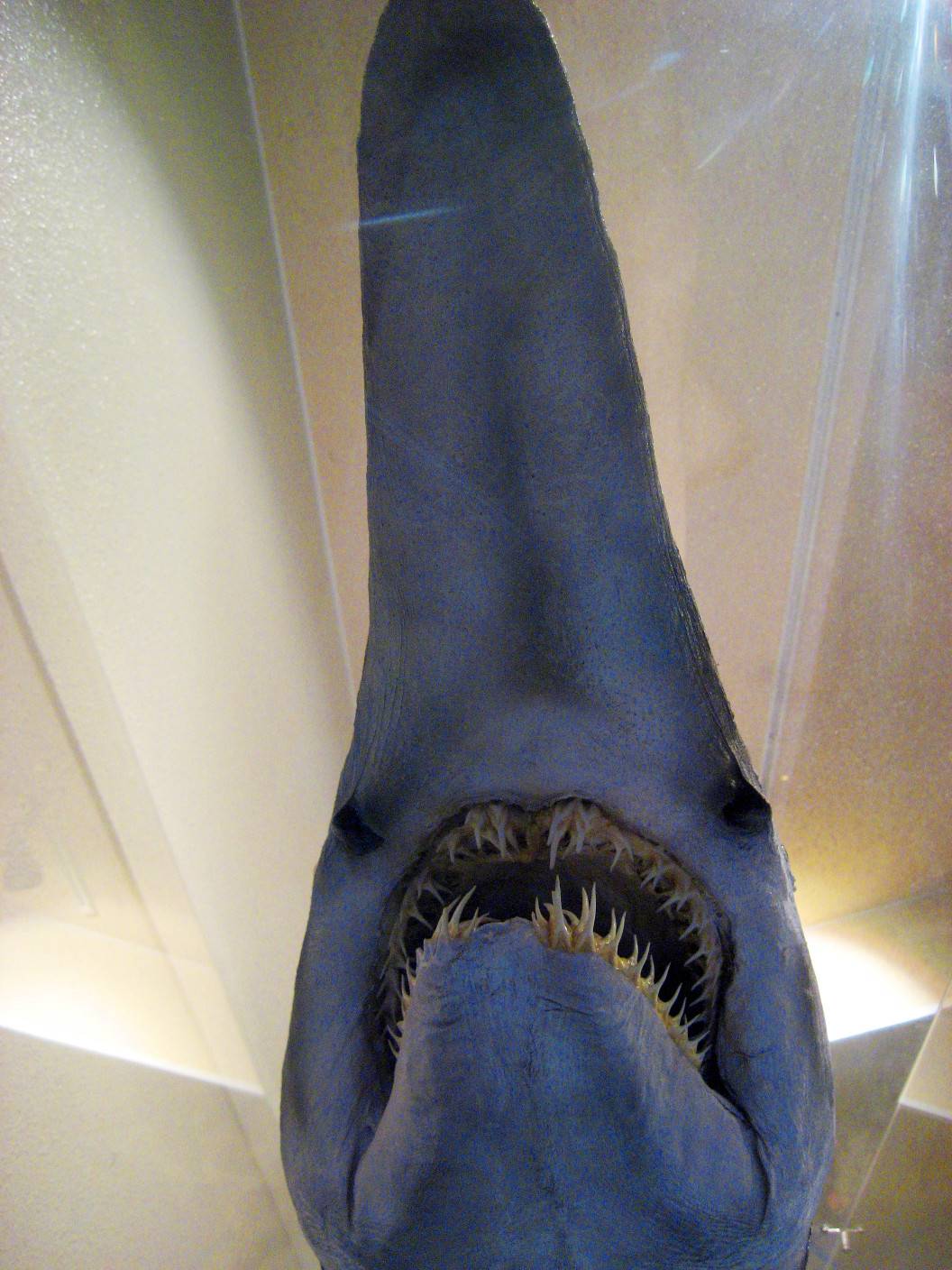
The goblin shark (Mitsukurina owstoni) is one of the ocean's strangest and least-understood animals — a pink-skinned deep-sea predator with a long, blade-like snout and jaws that shoot forward like a slingshot to seize fish, squid and crustaceans. Until now, almost every glimpse of a living one came after it had been hauled up on a fishing line, only to die soon after reaching the surface.
That has changed with two rare encounters described in the Journal of Fish Biology by a team led by the University of Hawai'i at Mānoa. For the first time, scientists have documented healthy goblin sharks swimming freely in their natural habitat, without removing them from the deep.
"Seeing the most iconic of all the deep-sea sharks alive and looking healthy in its natural habitat is a unique honor," said lead author Aaron Judah, a doctoral researcher in the university's Deep-Sea Animal Research Center.
Two chance sightings, thousands of miles apart
The first came to light almost by accident. In 2025, Judah learned that colleagues might have recorded a goblin shark during a 2019 Ocean Exploration Trust expedition aboard the E/V Nautilus, which surveyed the Pacific Remote Islands Marine National Monument. Reviewing the archived, publicly available footage from the remotely operated vehicle Hercules, he confirmed a roughly 11-foot male — estimated from its size to be more than 50 years old — gliding past a seamount near Jarvis Island at about 4,000 feet.
The second was captured in 2024, when a separate team from the Minderoo-UWA Deep-Sea Research Center lowered baited cameras into the Tonga Trench. A goblin shark, thought to be female, drifted in front of the lens at around 6,550 feet — nearly 700 metres deeper than the species had ever been recorded, and a new depth record for the entire order of mackerel sharks that also includes great whites and makos.
Both sightings, in the Central Pacific, extend the animal's known range by thousands of miles. It had previously been documented only off the western United States, in the Gulf of Mexico, and near Australia, Japan and New Zealand.
For a species this poorly known, that reach matters beyond curiosity. Now that researchers know goblin sharks live in these waters, the animal can be added to regional biodiversity lists and factored into how the ocean is managed.
"New discoveries like this demonstrate that there is still so much to explore in our deep ocean home," Judah said, arguing that patient natural-history work — and carefully archived video — remains essential.