Sugar has long been treated as chemistry that requires planets. Now it has been found in a cloud of gas and dust near the centre of the Milky Way: an international team has detected erythrulose there — by their assessment the first true sugar identified in the space between stars. The work appears in "Nature Astronomy".
The word "true" carries weight. Glycolaldehyde was detected in interstellar space back in 2000 and is often called the simplest sugar. Chemically it is not one: a molecule needs a backbone of at least three carbon atoms, as astrochemist Brett McGuire of the Massachusetts Institute of Technology stresses. Erythrulose has four — on Earth it occurs in raspberries, among other places, and turns up in sunless tanning products.
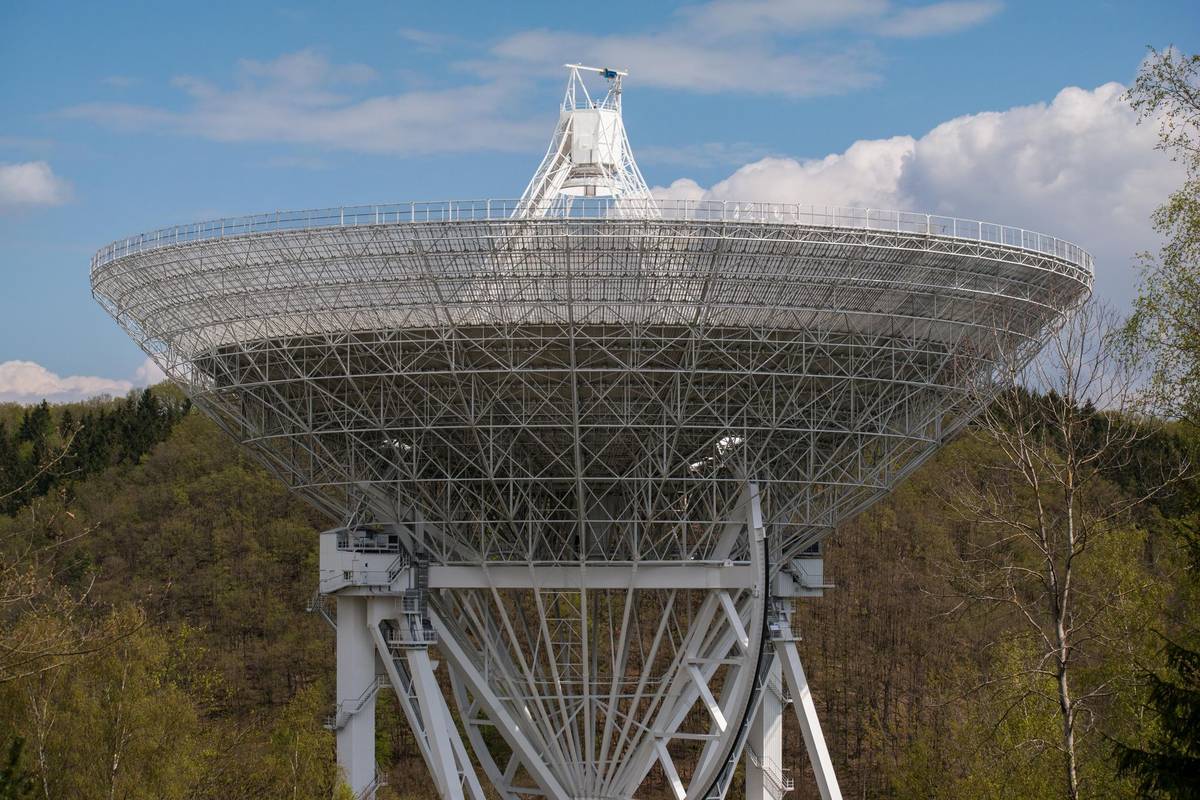
Lead author Izaskun Jiménez-Serra of the Spanish National Research Council had spent years searching for such molecules without success. In 2022 the physical chemist Emilio Cocinero of the University of the Basque Country offered to share laboratory spectroscopic data for erythrulose: the characteristic frequencies that identify a molecule beyond doubt. Sceptical, she checked them against her observations of the cloud G+0.693-0.027 — and the pattern was there. Deeper observations with the 40-metre radio telescope at Yebes and the IRAM 30-metre dish, both in Spain, brought the signal out more clearly. In the end twelve sets of frequencies matched erythrulose; the team had to model more than 180 further molecular species in the dataset to rule out interfering emission.
Chemistry against intuition
Two findings stand out as unexpected. The four-carbon sugar is at least eight times as abundant as comparable three-carbon molecules — even though larger molecules should be rarer in space. "We skipped all the three-carbon sugars," says McGuire, who worked the result into a lecture at Leiden Observatory on the day he first saw the preprint.
Second, erythrulose apparently does not grow one atom at a time. The team proposes that it forms on icy dust grains when two abundant two-carbon molecules react with each other: glycolaldehyde and ethylene glycol. Quantum chemical calculations and astrochemical simulations support that route under interstellar conditions.
For the question of life's origins this is more than a curiosity. It has been unclear whether the necessary quantities of sugar arose on the young Earth itself or arrived from outside; the five-carbon sugar ribose has already been found in meteorite samples billions of years old. The new detection supports the view that key building blocks formed in interstellar space before stars and planets existed and later reached Earth aboard comets or meteorites. The Kassel astrophysicist Thomas Giesen points to the time this buys: a dust grain and a little hydrocarbon chemistry suffice, and the process has billions of years to run.
Jiménez-Serra now wants to hunt for larger sugars — ribose and deoxyribose, the backbone components of RNA and DNA.