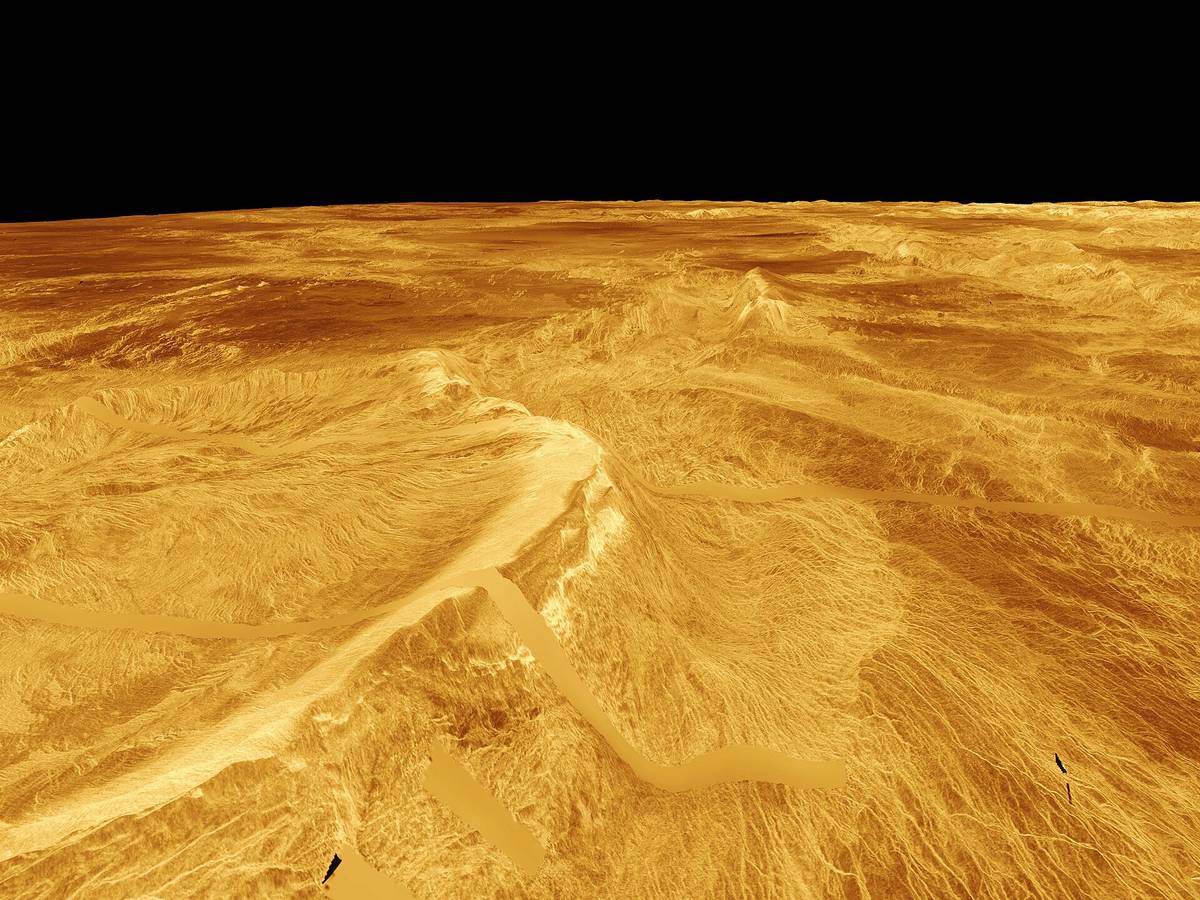
If you want to know whether a planet is still geologically alive, look at its fracture lines. Rift systems stretch up to 10,000 kilometres across Venus, far longer than East Africa's Rift Valley at roughly 6,000 kilometres. They were long taken for scars of a distant past: formed more than 100 million years ago and quiet ever since. A new simulation study from ETH Zurich reaches a different conclusion – some of these rifts are probably geologically young, and Earth's neighbour is more mobile inside than assumed.
For the work, published in Nature Geoscience, Xi Yang and Taras Gerya, professor of geodynamics in the Department of Earth and Planetary Sciences, modelled the rift systems Ganis Chasma, Dali Chasma and Devana Chasma in high-resolution three dimensions for the first time. Earlier models were mostly two-dimensional and simplified the properties of the rock considerably. The new thermomechanical model therefore reproduces the structures, and how they came about, far more precisely.
The decisive detail sits at the edges. Broad ridges pile up along the flanks of the rifts – and according to the simulations they only form while a rift is young, meaning still moving or only recently stilled. Once the stretching stops, the flanks subside comparatively quickly: the older the system, the flatter and narrower its edges. Unlike on Earth, where erosion wears the landscape down, on Venus this happens through relaxation of the crust. In passing, the calculations show the rifts opening faster than expected, at three to ten centimetres a year.
The test against Magellan
The proof lay in holding the model up against real observations. Wide, high flanks appear not only in the simulation but also in the radar images NASA's Magellan probe took of the Venusian surface in the 1990s. From that combination the researchers conclude that Venus remains an active planet with a more dynamic interior than previously believed – a finding that fits recent indications of active volcanism. "The results help us to better assess the tectonic activity on Venus," Gerya says.
The practical value lies above all with the coming generation of Venus missions: the model can narrow down which regions are worth closer study because something is still happening there. Beyond that, the work sharpens our understanding of how rocky planets develop at all – down to the question of how rocky planets around other stars might be recognised. Venus, a neighbour with a surface temperature of around 460 degrees Celsius and crushing atmospheric pressure, thus becomes a comparison case for Earth itself.