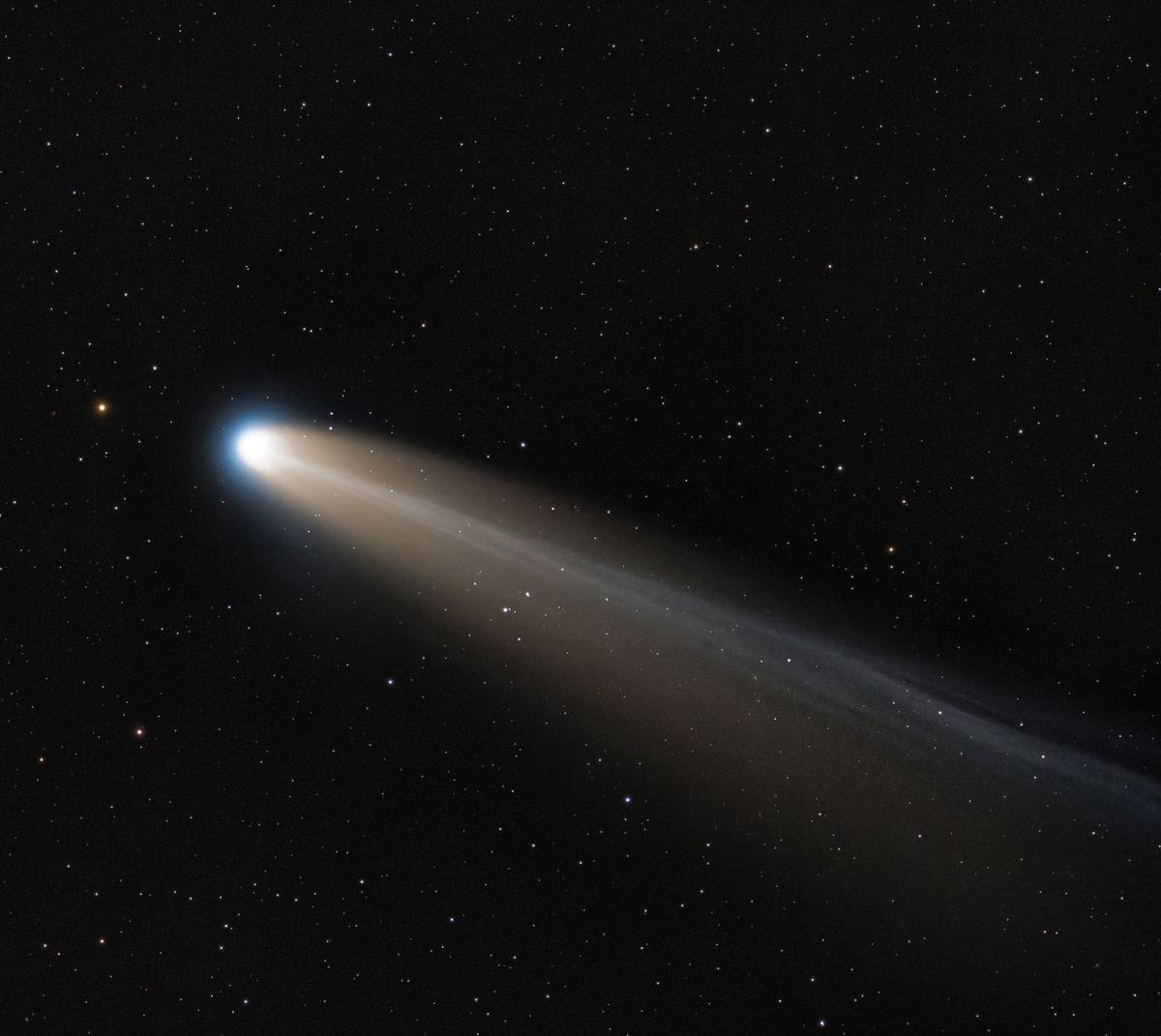
For 27 years, astronomers thought they knew the near-Earth object called 1998 SH2. Then it went missing. During a close pass of Earth in August 2025, the body drifted far from where every calculation said it should be — and following that discrepancy has led a NASA team to reclassify it entirely: what had been catalogued as an asteroid is in fact a comet.
The object had been tracked since its discovery in 1998, and nearly three decades of position measurements seemed to pin down its 4½-year orbit around the Sun. On 28 August 2025 it passed safely within about 3 million kilometres of Earth. But when researchers at NASA's Deep Space Network aimed their planetary radar where the object should have been, it wasn't there.
Nineteen standard deviations off course
An observatory in Serra da Piedade, Brazil, recovered the wanderer optically. Compared with a gravity-only prediction — the kind that works perfectly for an ordinary asteroid — 1998 SH2 sat a staggering 19 standard deviations from its expected spot. Something beyond the pull of the Sun and planets was nudging it along.
That something, the team concluded, is the gentle thrust of gas escaping from the body itself — the hallmark of a comet. "After we measured the nongravitational perturbations affecting the motion of 1998 SH2 and recognised they weren't compatible with the object being an asteroid, we suspected the object could be an active comet," said Davide Farnocchia of NASA's Jet Propulsion Laboratory. The findings were published in the journal Nature Astronomy.
1998 SH2 belongs to a rare and elusive class known as "dark comets": bodies that look like asteroids, showing no obvious tail or coma, yet betray their true nature through their motion. Confirming one is more than a bookkeeping fix. Every object whose behaviour astronomers can predict with confidence strengthens the wider effort to map and monitor the near-Earth population — the same painstaking work that underpins planetary defence. A lost asteroid, in the end, turned into a lesson in how much the solar system can still surprise us.