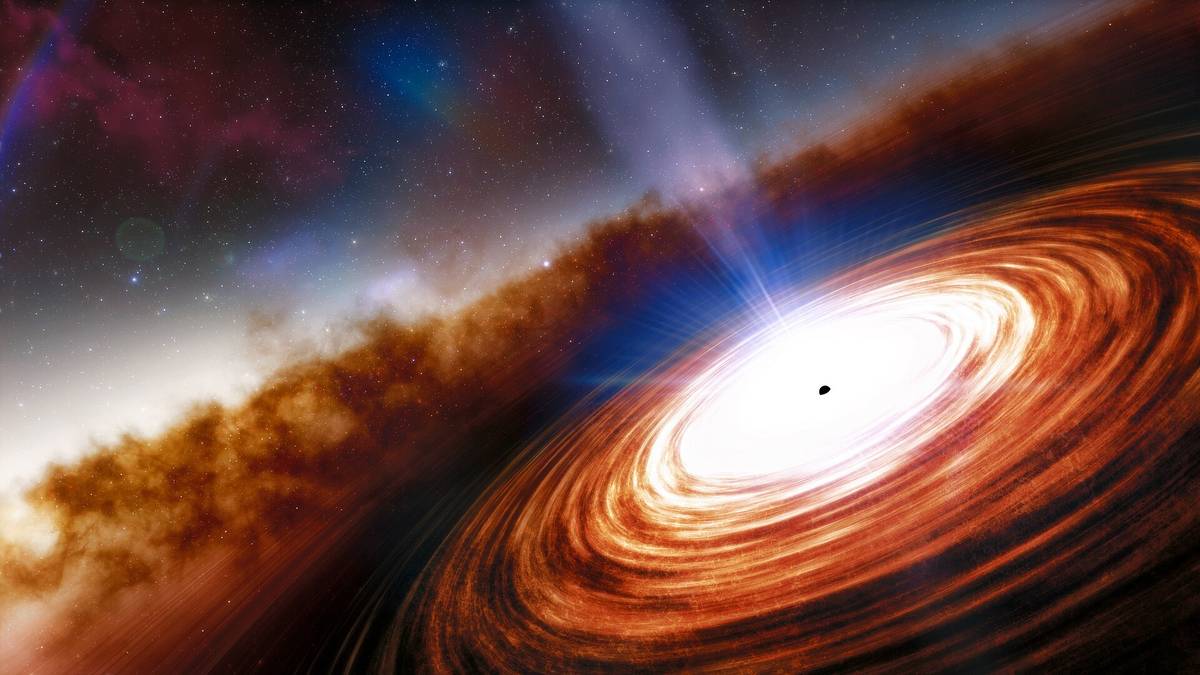
Astronomers have identified 31 of the oldest quasars ever recorded — among them two that were already blazing with the light of roughly a trillion Suns when the universe was just 670 million years old, about 5% of its present age. The discovery, made with the European Space Agency's Euclid space telescope and published on 6 July in Astronomy & Astrophysics, more than doubles the known population of these earliest cosmic beacons.
A quasar marks a brief, dazzling chapter in a galaxy's life. Gas and dust spiral toward a central supermassive black hole, heating to millions of degrees and releasing so much energy that the galaxy's core can briefly outshine everything else in the cosmos. Because such objects are visible across billions of light-years, they serve as rare signposts to the universe's infancy.
Finding the very earliest ones has long frustrated researchers. Quasars from this epoch are scarce, because few galaxies had grown large enough to host them, and their faint, ancient light is easily mistaken for that of nearby stars. As space expands, that light is also stretched into the infrared — wavelengths in which Earth's own atmosphere glows, blinding ground-based telescopes. Observing from orbit sidesteps the problem.
A census, not just the brightest few
Euclid, launched in 2023, was built to survey vast swaths of sky at great depth. Sorting through tens of millions of light sources with machine-learning tools, the team drew its 31 quasars from the Euclid Wide Survey, which will eventually map more than a third of the sky. “Before, we could only find a handful of the very brightest ancient quasars,” said lead author Daming Yang of Leiden University. “Euclid lets us search far more efficiently across huge areas of sky.”
The two record-holders, catalogued as EUCL J172902.75+641018.1 and EUCL J125308.55+705432.3, sit at redshifts of 7.77 and 7.69 and lie just over 13 billion light-years away, edging past the previous record set in 2021. Their existence sharpens a genuine puzzle: how black holes weighing hundreds of millions of Suns assembled so quickly. A closer look at the second-oldest, led by Silvia Belladitta, found it nestled in a dusty, gas-rich galaxy furiously forming new stars — an early clue to where such giants take shape.
Where it once took more than a decade to find the first ten quasars this distant, Euclid has now surpassed that in a single year. The mission, led by ESA with contributions from NASA, will also help guide the forthcoming Nancy Grace Roman Space Telescope. “The Euclid team has taken a true census of quasars at the dawn of the Universe for the first time,” said ESA researcher Antonio La Marca.