For more than twenty years, physicists have pursued an unusual idea: to derive time not from an atom's electrons, as clocks do today, but from its nucleus. Now the leap from idea to device has been made — twice over. A European team led by Thorsten Schumm at the Vienna University of Technology (TU Wien), which also includes Ekkehard Peik of Germany's national metrology institute PTB in Braunschweig, and a group led by Shiqian Ding at Tsinghua University in Beijing independently presented the first functioning nuclear clocks. Both works appeared in early June as not-yet-peer-reviewed preprints on the arXiv server.
The heart of both clocks is the same: a millimetre-sized crystal of calcium fluoride with atoms of the isotope thorium-229 embedded in it. Thorium is a special case because the energy levels of its nucleus lie so close together that even ultraviolet laser light can lift the nucleus into a higher state. Unlike today's precision clocks, the crystal need not be cooled to near absolute zero — it works at room temperature.
The decisive feedback loop
That the nucleus can be excited at all had already been shown. What was missing was the mechanism that turns an experiment into a real clock: a feedback loop that keeps the laser permanently locked to the nuclear frequency. To do this, the laser continually alternates between two frequencies just above and just below the resonance. If both are absorbed equally, it is correctly tuned; if the absorption differs, the clock corrects itself. In the Vienna set-up, the system ran for 24 hours without outside intervention.
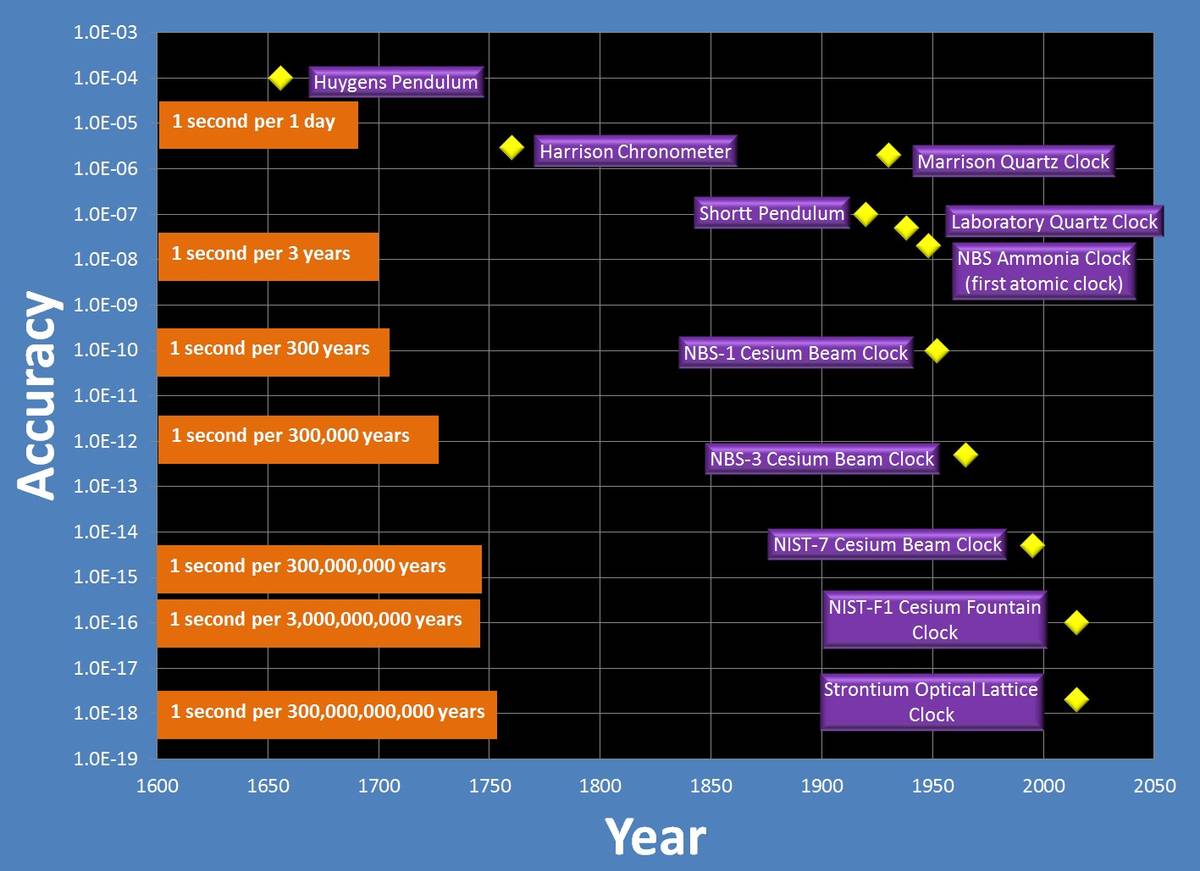
The nuclear clock does not yet match the stability of today's best atomic clocks: according to the Vienna paper, it currently loses a few dozen seconds over ten billion years. For comparison, a caesium atomic clock, whose electrons oscillate exactly 9,192,631,770 times per second, drifts by only about one second in 13 billion years at the PTB. Yet both teams stress that this is only a proof of concept, not yet optimised with the best lasers.
The appeal lies precisely in what is still possible. Because nuclei are barely disturbed by their surroundings, nuclear clocks are considered robust and compact — a path towards portable, highly accurate timekeepers for navigation and communication, with first commercial efforts already under way. At the same time, every running clock becomes a permanent sensor with which to test fundamental questions of physics and search for signs of dark matter, for instance. For Schumm, a dream has come true; the theorist Gilad Perez speaks of the “birth of a new field of research”.