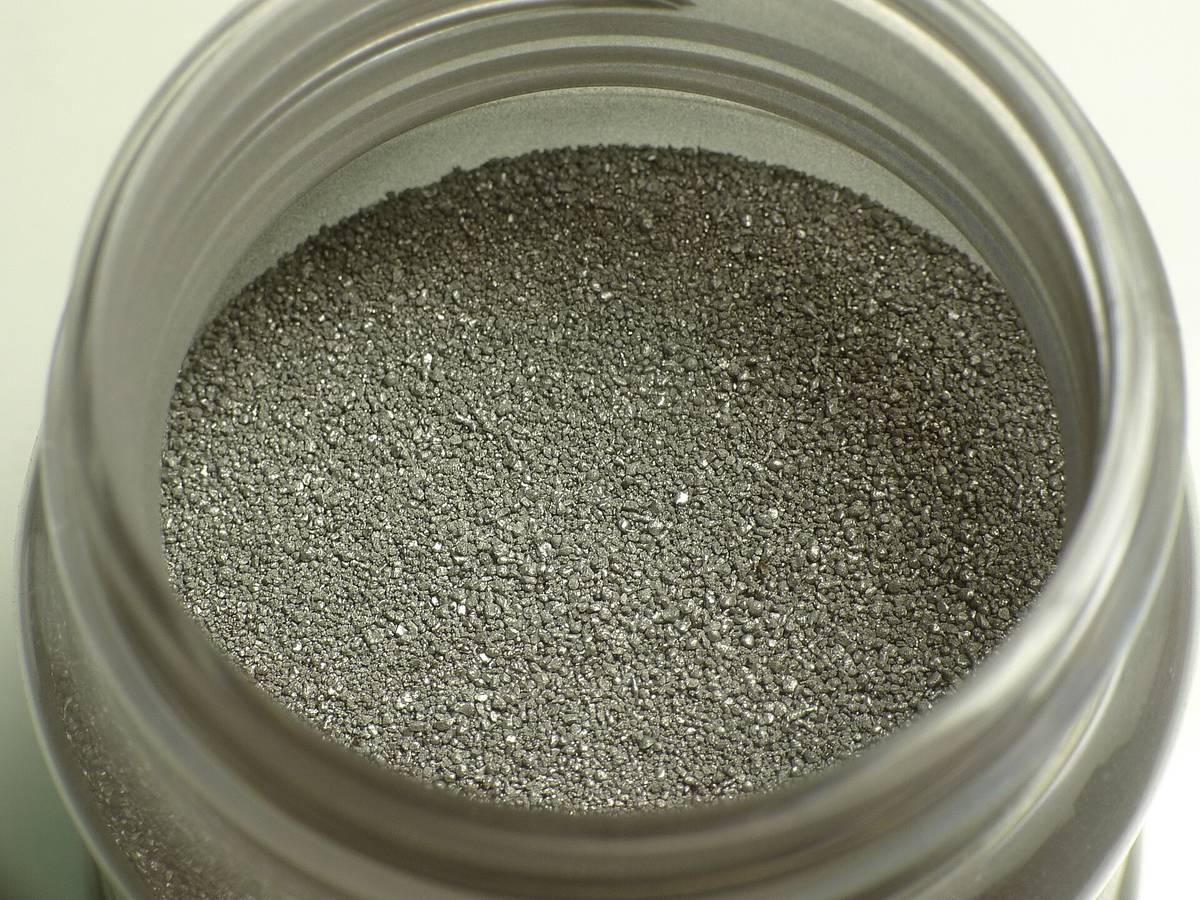
When wind and sun deliver too little power for weeks at a time, the energy transition has so far lacked simple long-term storage. A team at the Karlsruhe Institute of Technology (KIT) proposes an unusual candidate for the job: fine iron powder. In a study published in the journal Chem Circularity, the researchers have modelled comprehensively for the first time what role an iron cycle could play in a climate-neutral European power system.
The principle is a closed loop without carbon dioxide. Burning iron powder releases heat and produces iron oxide — ordinary rust. Using renewable hydrogen, the oxygen can be stripped from the rust again, leaving pure iron powder that can be burned once more. „This works in a cycle without carbon dioxide emissions or environmentally harmful substances," says Julia Schuler of KIT's Institute for Industrial Production.
One detail is decisive in practice: in the furnace, iron powder behaves much like coal. Existing coal-fired plants could therefore be retrofitted rather than shut down. Mainly the heat generator would need to be adapted; the steam cycle, turbines, generator and grid connection could be preserved. For Germany, with its many coal plants, the potential is accordingly especially large.
A complement to hydrogen, not a replacement
To gauge the benefit, the team extended the established energy-system model PERSEUS with retrofitted plants, reduction facilities and storage and transport routes, and used it to optimise the European energy system through 2050. The iron cycle competed against batteries, hydrogen storage and hydrogen power plants. The result: iron does not replace hydrogen-based power generation, but can usefully complement it — above all as seasonal long-term storage.
Its advantage lies in easy handling. While hydrogen needs pipelines, import terminals and underground storage, iron powder can be kept in ordinary warehouses and containers and shipped over long distances. Solar power from deserts or wind power from the coasts could thus reach where it is needed with little effort. Iron plants would be especially attractive in countries with little hydropower or few options for storing hydrogen underground; there they help bridge supply gaps and relieve the hydrogen infrastructure.
The authors regard it as an encouraging sign that iron-fired plants were part of the most cost-effective solution across every scenario examined. Whether a new „iron age" truly dawns depends, the study says, on how demanding the retrofit proves and how efficiently rust can be reduced back to iron in future. The extended model, PERSEUS-PtX, is publicly available together with its code and data, free for non-commercial use.